
![The narrow lens contrasts with a diverse reality; whitewashing means altering or concealing something to make it more appealing to white people. The word “whitewashed” as it is used today has caused identity crises for thousands, if not millions, of students. “I have been called whitewashed before, and it feels very sad. [It’s] just hard because it makes me not know who I am. You don’t get a lot of backlash for [saying it], so I think it’s a throwaway term for people who aren’t affected by it. When you are the person [who] is being called whitewashed, over time, it builds up,” sophomore Raaga Golla said.](https://pwestpathfinder.com/wp-content/uploads/2026/01/IMG_5740-1.jpg)


When I was younger, my mom took my brother and me to an aquarium in Springfield, Mo. We were on our way to a movie showing there when an usher stopped us to ask for our tickets. First, in an attempt to make small talk, she asked if my mom was our babysitter. Next, she asked if she was our cousin. My mom doesn’t remember this story, but as we were walking away, she expressed sadness. My brother and I asked why. She said, “She didn’t think I was your mom.”
Growing up biracial, with a white mom and a Black dad, I have understood the privileges and challenges that come with my race. When I went to school, I was surrounded by white students, and I met a few Black students, but I realized that I spoke differently than they did (I was fairly unfamiliar with African American English at the time). At the same time, it was apparent that I was different from my white peers too; they always asked to touch my hair and — more often than not — did so without asking. Later in my school career, I endured the onslaught of watermelon, monkey, fried chicken, Black-people-can’t-swim, Black-and-runs-fast and Black-but-can’t-play-basketball “jokes.”
I’ve been subject to many such microaggressions, but the one that always hurt the most was the “he’s-only-50%” “joke.” I was proud to be Black, yet I ended up questioning my identity — questioning if I was Black enough. I felt diluted — like I was not really Black, nor was I white; I call this my mixed feelings. And so began the relentless itch beneath my skin and the endless repetition of one question against my skull: because I grew up in a predominantly white environment, was I any less Black? In other words, was I whitewashed?
The word “whitewashed” has many different meanings, varying depending on the context. In the context of history and media, it can help bring equitable representation. In its more novel role in social interactions, it can alienate individuals from their culture and strengthen discrimination.
Race and identity
Race and racism, relative to the history of humanity, are new concepts. The word “racism” was first recorded in 1902, attributed to Richard Henry Pratt. However, race, as a means of classifying human beings based on physical traits and ancestry, has its origins in the 16th and 17th centuries, coinciding with European colonialism and imperialism. Then, an individual’s racial identity “justified” slavery, rape, incarceration, genocide and segregation; today, racism is condemned, and more protections are attempting to reduce racial discrimination.
Race is a socially constructed system, like money. For example, a sheet of paper with “100” in the corners has little intrinsic value, but we give it value through agreement. However, while race is a social construct, racial hierarchy is not. That is why race matters. It is not because one’s race determines one’s ability — which is delusional — but because dominant groups have historically imposed varying values, hierarchies and assumptions on racial categories.
So if race derives its power from society, why is it so hard to dismantle it?
As much as we can try, we cannot forget about race — nor should we. First, despite laws and protections in place, racists still exist. America’s population today is too diverse to ever entirely agree on anything. Racism worked as an agreement initially because of the hateful, vilifying nature of greed and power, working to unite the oppressors. Second, racism doesn’t exist solely in our minds. Racism still impacts the way people of color interact with America, and vice versa, through existing inequities and by manifesting in legislation that disproportionately affects people of color. Third, we all carry racial bias. We don’t want to admit it, but we all have implicit bias, or unconscious prejudice, because we have grown up in a society that is still grappling with the history of explicit racism. We can’t forget race because, without it, we have no structure to evaluate and eliminate our pre-existing biases. Race, while not biologically real, is socially real.
It matters because it has mattered, and it should matter because it still shapes millions of lives. Ignoring race does not solve historical inequities. Hence, we cannot erase race from — or whitewash — history.
Whitewashing in history
Whitewash was popular in the 16th century and was used to make houses appear whiter without cleaning. In the 20th century, however, the definition of whitewashing evolved to its most common usage today: the attempt to conceal something, typically negative. In history, this translates to omitting the voices, tales and contributions of people of color — something English teacher Kim Hanan-West noticed 20 years ago when she visited Monticello, former president Thomas Jefferson’s residence and plantation.
There, Hanan-West discovered memorials with overwhelming praise for Jefferson and his accomplishments, as well as a noticeable absence of representation for the enslaved Black people who worked there. Additionally, Monticello contained little information about Sally Hemings, an enslaved girl who bore six of Jefferson’s children; she was 16 years old upon delivering the first child. In 1998, a DNA study found more than 10 Black people related to Jefferson. Today, the suspected number of descendants is much larger. In 2017, after the history of Jefferson’s nonconsensual relationship had been whitewashed and dismissed as an “affair,” Sally Hemings’ room was discovered next to Jefferson’s. It had been converted into a restroom in 1941.
“Since [her room was discovered], Jefferson is no longer couched as this perfect master who was amenable and liberal. He is presented as a man of the Enlightenment, who was intelligent, but [these were] his flaws and blind spots. Prior to [the discovery], he was given a polish or a veneer, and the fact that he benefited financially from chattel slavery, that he had written extremely horrific things about the way in which he felt African Americans or Africans were a lesser species than the white man — those things were glossed over. He was instead lauded for his inventions and his part in writing the Constitution,” Hanan-West said.
School curricula across the country celebrate the Founding Fathers while failing to acknowledge their overall role in fostering the slave trade. For their complexity, breadth and surrounding controversy, subjects like slavery are often difficult to teach accurately in schools, especially to younger children, but such topics should never be whitewashed or lack honesty.
Like most young students, I learned about Christopher Columbus’s “discovery” of America, despite it already being populated by indigenous peoples. The problem was that the horrific things Columbus did were seemingly omitted from these history lessons. Similarly, at my Christian preschool, I was inundated with images of a white Jesus with blue eyes — much different from his true Middle Eastern and Jewish heritage.
All of these examples show historical whitewashing, the practice of omitting people of color from history. When the word “whitewashing” is used to describe history, it is often critical, seeking to bring balanced and truthful attention to important topics and marginalized peoples in today’s society.
“I think it is helpful [to] recognize historically when people have whitewashed native experiences. In that [sense], it can be helpful because it shows how American culture or European culture has overpowered Asian [cultures or the] cultures of [other] people of color,” sophomore Raaga Golla said.
Whitewashing in media
Extending the societal presence of whitewashing, the phenomenon also occurs in the film industry. The use of the word “whitewashing” especially increased as a result of casting practices in Hollywood, where directors would cast white actors to play people of color. The movie Doctor Strange included whitewashing, casting Tilda Swinton, a white actress, as the Ancient One, who is Asian in the original comic books. Whitewashing, however, also exists in literature. For instance, the book “To Kill a Mockingbird” follows Scout Finch and her father, Atticus Finch, as he tries to defend Tom Robinson, an innocent Black man, in court, but it largely ignores the perspectives of Tom and his wife, Helen.
“There is some whitewash in [To Kill a Mockingbird] when you look at the end and how Tom Robinson’s death impacts the Finch family [instead of] how it impacted the Black community or Helen,” Hanan-West said. “Also, Atticus [says] there’s no such thing as the Ku Klux Klan anymore. [He says] it’s gone. Not true. He whitewashes that moment, but it’s only because he’s privileged, and the Klan doesn’t impact his life.”
However, in the last few decades, whitewashing has come to take a different meaning socially, especially for the younger generation. While whitewashing has impacted history and English classes at West High, it has also affected students’ everyday lives.
“You can see it in literature, you see it in history, but I didn’t know that it was a disparaging term for kids or other people,” Hanan-West said.
Whitewashing in a social context
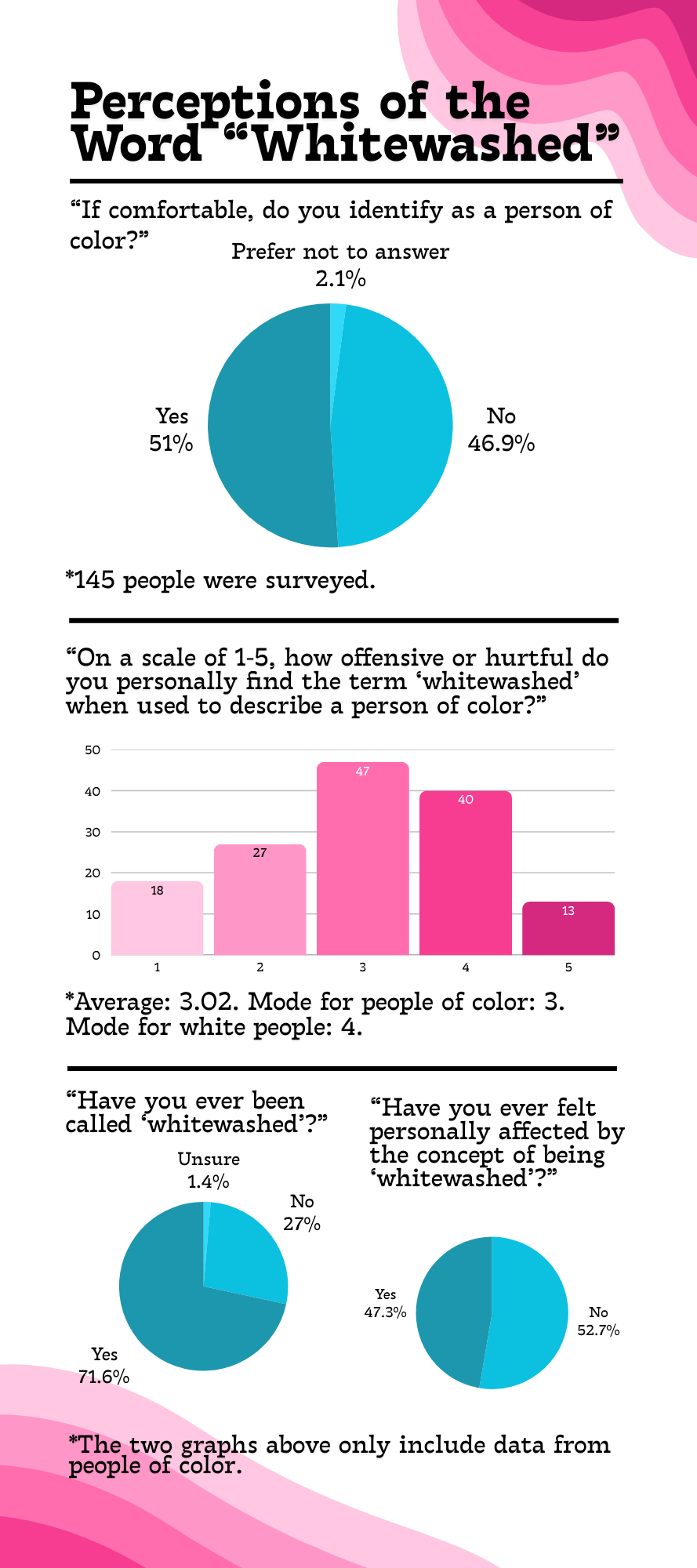
A survey conducted by Pathfinder found that 71.6% of students of color had been called “whitewashed” at some point in their lives. (The study included four students who replied that others suggested that they were culturally assimilated or Americanized rather than “whitewashed.”) 74 students of color took part in the survey.
I, too, have been called “whitewashed” in my life, but there appears to have been a cultural shift in its meaning. While collecting data, I observed that members of older generations were more likely to correlate whitewashing with its meaning in a historical context. In contrast, students were more familiar with the word in a social context, where “whitewashed” is a descriptor of a person. In this case, “whitewashing” describes the act of concealing one’s culture as a means of assimilating into Western or American culture to please white people. It’s typically a pejorative.
“I feel as though it diminishes the cultural identity of people of color. Specifically, some of my best friends are people of color, and it’s very frustrating to me that they are [called] ‘whitewashed’ because of who they hang out with and how they act,” junior Julia Brandmill said.
The misuse of the word has opened the door to terrible racial discrimination, for it posits that style, attitude, actions and academics have inherent ties to race, reinforcing racial stereotypes.
“It gives you a feeling that you’re not good enough. [You ask], ‘What more can I do to please you? — To make you see that I am not whitewashed?’ People of color face backlash for being too much in their own culture, but if they get called whitewashed, they get backlash for not being in touch with their culture. It’s a really hard position to be in because you can never find that perfect balance,” Golla said.
The survey found that students of color who had been called “whitewashed” were 2.19 times more likely to answer that they’d felt “personally affected by the concept of being whitewashed,” implying a strong correlation between the label and psychological distress.
“It reinforces the idea that you have to look, act or behave a certain way to be your culture if you’re a person of color, like if you don’t fulfill a certain checklist, you’re less Black or less Asian or Indian. When you label somebody as whitewashed, it takes away from the fact that they are probably [still] in touch with their culture; they’re just growing up in America,” Golla said.
The double consciousness
Since the day I noticed my skin was different from the majority of my peers, a sense of racial awareness has manifested itself in the form of double consciousness.
Black author, sociologist, historian and civil rights activist W.E.B. Du Bois coined the term “double consciousness” in 1903, with the release of his book, “The Souls of Black Folk.” Du Bois described it as the internal conflict Black people experienced in America, caused by seeing themselves through their own eyes and through the eyes of a racist society. Today, however, it has evolved to encompass people from various marginalized groups.
“As a person of color in America, surrounded by white people, it is hard to figure out who you are because you don’t have to always be American, or you don’t have to always be in your culture. You can be either one, but I think the term ‘whitewash’ labels you as someone who doesn’t know who they are and disregards their culture,” Golla said.
Du Bois believed that one could maintain these often warring identities without losing the essence of either.
“I think people [around me] have matured and realized that you can be both a person of color and you can be a person that lives in America. But I think in middle school, when people were [more] immature, the term would be thrown around much more frequently, and it would be much more insulting. I think now people have realized the weight that that word carries, so they haven’t said it as much,” Golla said.
The existence of double consciousness makes the word “whitewashed” particularly sensitive. Its use in social contexts only exacerbates the identity crises of adolescents, who are still navigating their place in American society. Furthermore, when one uses the word in a derogatory manner to describe another person, they are implying that they have some cultural “superiority,” judging cultural authenticity through their own lens. In essence, they shame the victim for “diverging” from their prescribed culture. However, at the same time, the accusation insinuates that the victim’s culture is somehow inferior by the definition of the word whitewashing. For this reason, the word both reinforces racial hierarchies and divides members of the same race. It’s paradoxical and the effect of internalized oppression.
Internalized oppression
In eighth grade, I was tasked with creating a presentation to introduce myself to my class. I had chosen a photo of myself that I was particularly fond of, but when I came to present it, one of my classmates joked that I’d enlarged my lips. I hadn’t. After this, I got into the habit of smiling more often or sucking my lips into a thin line to hide them from scrutiny. It took me nearly three years to realize the effect that one comment had on my self-esteem.
For me, my lips — a source of cultural pride — became something that I was ashamed of; this idea is at the center of internalized oppression: people’s absorption of negative stereotypes, beliefs and societal messages, typically causing a damaging change in that person’s attitude, self-perception or behavior. Internalized oppression consistently draws upon racial stereotypes.
“I’ve personally only ever been called whitewashed by other Black people. [Some people] associate things that would help them succeed, like trying harder in school [or] putting your best foot forward, [with whitewashing]. If they consider all that being ‘whitewashed’ and don’t want to be a part of that, that’s really holding back the Black community, and it enforces a lot of bad stereotypes,” junior Nia Rilpuou said.
By characterizing certain habits as typical of a particular race, internalized oppression creates identity conflicts, which lead to the weaponization of positive traits.
“One of the things that I have always failed to understand [is] how positive traits like excelling academically become a ‘white’ trait. That’s one of the more disturbing things to me. That speaks to internalized oppression, [and] I think that’s something that we don’t talk about enough. We’re afraid to talk about hard things, and so we don’t talk about how resenting academic progress and saying, ‘that’s a white thing’ is part of that oppression that you’ve internalized from the world,” Hanan-West said.
That comment, from a bold classmate, pushed me to internalize Eurocentric beauty standards, which led to a negative self-image. Since that day, I’ve spoken about the comment’s effect on my psyche with educators at The Equity Exchange in the summer. One such educator told me, “Today, people pay for lips like those.”
Reflection
Thinking about my own relationship with race, I contemplated the following thought experiment: Were Africans any less Black when they arrived in Charleston in slave ships? Were they any less Black when they picked up English or created creole languages? How about when they began preaching the gospel? What about their children, the descendants of racists and rapists — were they any less Black than their ancestors? I think not. In fact, these experiences united Black people and encouraged us to dig deeper and find our cultural roots — to redefine or reconnect with them.
Like the Ship of Theseus, every generation weaves its own traditions into the fabric of culture. We are the same people, connected to the same ancestors, and yet we continue to change over time. Cultural change does not dilute racial identity. We define what it means to be Black, Asian or part of any community. Most importantly, we define these things for ourselves.
“Being whitewashed isn’t about doing your hair a certain way [or] being a certain way. You don’t have to conform to these black stereotypes to be accepted by the Black community,” Rilpuou said. “If [you dress] a certain way or [carry] yourself differently than what African American stereotypes want you to carry yourself as, that’s not your problem. It’s a problem with the community.”
The word “whitewashed” is like a camera. The photographer assumes their photographs reveal an objective reality — an individual’s “lack” of culture. But this camera is limited in its scope and deceiving in its angle. It is the photographer — the racial profiler — that decides, intentionally or unintentionally, what photos are taken, and so while a photo may appear concrete and accurate, the photographer is always biased and, more often than not, ignorant, staring into a colorblind viewfinder. The truth of diversity evades the photographer no matter how fast they pan, so to find it, they first must set down the camera. Culture is something to be experienced, not captured, so stop judging and labeling people. Open your eyes, and try seeing the world from a different perspective.
While there is no such thing as acting like a certain race, assimilation, whether it is borne from necessity or desire, is a concern or reality for many immigrants and people of color. The word “whitewashed” encourages students to “pick a side.” In other words, the concept of social whitewashing promotes binary thinking, proposing that to be accepted in a community, you must let go of your own cultural ties and assimilate into the dominant culture — the equivalent of dissolving or, rather, suppressing your double consciousness.
In the social context, the disparaging word “whitewashed” is a vehicle for internalized oppression and general bigotry. Whether they are a person of color, an immigrant, or a non-Western white person, this word has an often unseen impact on these communities, and that is why, henceforth, it need not and should not be used to describe anybody.
“One big step that I would love to see is teachers not taking it lightly when they hear someone call another person whitewashed. If you say a slur at school, it’s a big deal [and] you’re going to get in trouble for it, but I feel like [the punishment] is very selective to who it applies to. If you call a certain race a slur, you’ll get suspended. If you call someone ‘whitewashed’ or a ‘curry muncher,’ for example, I’ve never seen anyone get in trouble for it, even though it happens right under the teacher’s nose,” Golla said. “A way to make every culture respect each other would be to not take it lightly when these derogatory terms are being thrown around. Among students, it’s important to recognize that everyone’s culture is different, and everyone [is] worthy of being treated equally and with respect.”
Through the exploration of my own identity, I am attuning my double consciousness, and I hope other students will begin exploring their identity too, throwing caution to the wind and ignoring what anyone else may think. Some already have; regardless of alleged “whitewashing,” many students of color at West have found solace in being unapologetically themselves — just as they should.
![Takeout containers and boxes sit unused in the garage of senior Yein Ahn. Her family’s sushi restaurant, 153 Sushi, went out of business in March 2024. Like many restaurants, Ahn’s family experienced the struggle of the restaurant business amidst the lasting economic effects of the COVID-19 pandemic. Business teacher Andy Croley has been teaching his classes about these modern challenges restaurants face trying to adapt to the rapidly changing economy and market. “[The food industry is] super competitive. There are restaurants everywhere you go, so they have to figure out what niche they're going to fill. Then, just like us as consumers, right now at home, where our prices are going, prices [for restaurants] are continuously going up as well. Inflation would definitely be a factor for people as well, because with inflation, [restaurants] are also seeing rising costs in their lease or their rent, electricity and all across the board,” Croley said.](https://pwestpathfinder.com/wp-content/uploads/2026/05/DSC_0004-1200x800.jpeg)
![From March 12 to 23, 38 Parkway School District Latin students and six chaperones journeyed across the Atlantic Ocean to visit Italy. Throughout the trip, students noticed an unusually high level of military presence at the sites they visited. “[It] seems like a lot of people are unhappy with our country’s current foreign affairs [and] foreign policy. I think that affects people's view [of] our country and our people as a whole. [We saw] signs [and] graffiti with anti-American sentiment. I think there's fear all over the world, and people don’t know what's going to happen next,” junior Jackson Stirling said.](https://pwestpathfinder.com/wp-content/uploads/2026/03/march-feature-revised--1200x675.png)
![Laughing, sophomore Julia Adams (right) takes time from her day to let loose and hang out with her friends. Adams, who has received lessons from Parkway’s Peers Advocating for Total Health (PATH) program, has maintained the status of being alcohol free. “Playing sports, [and] being surrounding myself with friends who encourage each other to [not drink] is [not only] helpful, [but] doing these activities is super fun and helps me reach a natural high,” Adams said.](https://pwestpathfinder.com/wp-content/uploads/2026/03/DSC_0029-1200x800.jpg)

![Reflecting on the hallway artwork titled “Community and Connections,” junior Trent Young is inspired by the unity and belonging showcased at school. This painting was created in 2014 to represent West's diverse population.“Seeing someone of color, [Zohran Mamdani], succeed in politics makes me realize I belong here. It inspires me to get involved within my community [to] make a difference,” Young said.](https://pwestpathfinder.com/wp-content/uploads/2026/01/DSC_0002-1200x800.jpg)
![Playing an informative video about DECA competitions, sophomore Eiley Minich leads the first DECA meeting of the year. Like Minich, senior Tenley Dollarhide is a member of DECA. “I think [DECA is ] important because they provide good personal experiences that relate to your career. I want to do business so I can get actual experience in doing marketing projects, competing with other business students [and] presenting things with an actual business person as a judge. I think it's important to make them more inclusive, because we want to have a diverse population. You need people with different perspectives to bring their perspectives to the table and talk about what people like them they need,” Dollarhide said.](https://pwestpathfinder.com/wp-content/uploads/2025/12/DSC_1446-2-1200x795.jpg)
![During Creative Writing, senior Michael Collop experiments with different poetry styles. For Collop, the class feels like a break from the fast pace of his other courses. “[There is] no stress,” Collop said. “It's definitely a lot more laid back [than an AP class], and it's enjoyable. It's probably one of my favorite classes.”](https://pwestpathfinder.com/wp-content/uploads/2025/12/DSC_4545-1-1200x800.jpg)
![Helping to transport cans and other food items from West High’s food drive to the Parkway Food Pantry, sophomore Max Jones carries a box into a truck. Nov. 21 marked the end of West High’s annual canned food drive. “The food drive is a really great opportunity for everyone to get involved in helping a bigger cause. It’s great that [the West community] can make a difference in a big way through this food drive,” Jones said.](https://pwestpathfinder.com/wp-content/uploads/2025/11/DSC_0727-1200x798.jpg)

![Amid major global conflicts, anonymous social media critics hone in on celebrities, especially female celebrities, every move. Taylor Swift's latest album release and accompanying press tour displayed the uncontrollable growth of cancel culture and the comfort anonymity on social media has created. “[Cancel culture] can be very effective when [it’s used to] speak out against a [person] or a corporation where [you] use your voice or your dollar as a way to send a message about what we accept as a society. [However,] we've really blurred this line where we expect [everyone] to cater to have a belief about every issue. Not one person is going to believe every single thing that you believe as strongly as you believe it," English teacher Michelle Kerpash said.](https://pwestpathfinder.com/wp-content/uploads/2025/11/DSC_7626-1-1200x800.jpg)
Sanjana Daggubati • Feb 6, 2026 at 8:47 am
Sage, this piece is truly incredible! I feel like you incorporated every journalistic element while writing about such an important topic! I don’t know how you came up with that title, but it fits perfectly!
Darla Kelly • Feb 4, 2026 at 6:25 pm
Darla Kelly
I just read your writings about “whitewashed”, what an amazing story. I oftened wondered what form of racism you had experienced, if any? I would never want you or anyone for that matter to endure the ugliness of it. I am so proud of your accomplishments thus far and know that you will do great things in the future. I am proud of you and your brother. Your mother and father have done a great job of raising you and your brother to be respectable young men. Keep up the good work. I love you ❤️
Adam Chadwick • Feb 2, 2026 at 9:50 am
Excellent think-piece, Sage. Thanks for sharing.
MARY T CLINE • Feb 1, 2026 at 5:17 pm
Thank you, Sage, for another great article. You constantly open my eyes to others feelings. I love your sharing of not only your story, but those of your fellow students. Well done!
Raaga Golla • Jan 31, 2026 at 6:36 pm
Sage, this truly is an amazing peice– I was nodding my head, eyebrows raised, thinking “this is SO true,” with basically every line. Thanks for allowing myself and so many others to share our story and truly doing this issue justice. You rock!
Max Chung • Jan 30, 2026 at 7:32 pm
Absolutely fantastic, Sage! Probably my favorite read in recent times.