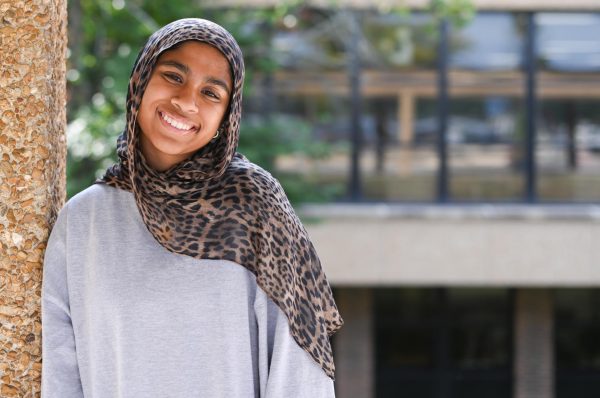
![Reflecting on the hallway artwork titled “Community and Connections,” junior Trent Young is inspired by the unity and belonging showcased at school. This painting was created in 2014 to represent West's diverse population.“Seeing someone of color, [Zohran Mamdani], succeed in politics makes me realize I belong here. It inspires me to get involved within my community [to] make a difference,” Young said.](https://pwestpathfinder.com/wp-content/uploads/2026/01/DSC_0002.jpg)
On Jan.1, Zohran Mamdani became the first Muslim mayor of New York City. His election represented a shift in leadership toward greater cultural and religious representation within one of the most authoritative political offices in the United States. During his time in the state legislature, he supported rent stabilization efforts and aligned himself with working-class citizens facing rising rents and housing instability. This victory is monumental, especially for underrepresented communities, because it shows that candidates who prioritize marginalized voices can succeed.
For the Muslims of New York and other groups, his win also breaks many barriers in city politics, suggesting that one’s religious identity is no longer an obstacle to being able to hold a political position. Mamdani’s election reflects voter support for his visible policy proposals, such as expanding public transit access and addressing income inequality. Voters were drawn to Mamdani because he consistently connected his political work to working-class concerns; he did this by showing up in different neighborhoods, listening to the residents, and turning those priorities into actionable legislation.
Mamdani’s campaign focused on making the biggest city in the United States affordable. He addressed economic inequality and rising costs in New York City, promising to lower them. After Mamdani publicly labeled himself a democratic socialist, he highlighted his commitment to achieving social and economic equality through democratic processes, such as legislation and voter-approved reforms. Despite this, critics had misrepresented his platform by comparing democratic socialism to economic collapse or government overreach. Opponents used scare tactics in campaign ads and public statements, stating that his proposals or promises would weaken public services or lead to excessive taxation.
Mamdani, however, faced negative comments and addressed the struggles of everyday individuals through his platform. He persevered, continuing to build his case for his actions by connecting with residents and building credibility and trust. Mamdani hopes to make New York more affordable, especially by allowing free public buses and implementing universal free childcare. His success shows that voters were more persuaded by specific practical policies and finding answers to their daily problems.
“People are realizing that terms like socialist are often used to scare or divide groups of people [surrounding the elections]. What really matters is that Mamdani [had a plan] to make life more affordable and fair for everyone. His win shows that Americans, especially young voters, are willing to support leaders who actually focus on solutions,” junior Elle Wendling said.
As the first millennial mayor of New York City, Mamdani brings a leadership style and energy that resonates with younger voters. He understands lived experiences such as rising housing costs, job insecurity, and student debt. He addresses these issues through platforms popular with younger voters, such as TikTok and Instagram. While doing this, he also explains many complex proposals, such as expanding on rent-stabilized housing or implementing targeted tax reform to reduce income inequality. Additionally, he uses more accessible forms that appeal to the older generation, who also care about improving their communities and family stability. Rather than using TikTok to connect with them, he attended community events that mattered to seniors. Meeting with senior groups, he heard their concerns about affordability and the cost of living. In-person engagement with older generations helped them build trust and address their generational concerns.
His social presence during the election cycle and even after his inauguration encouraged civic participation among younger voters and reinforced the idea that their perspectives are essential. His win spurred a surge in youth turnout and sparked interest in politics; this report showed that 18 to 29-year-olds expressed greater interest in politics and higher participation in the youth than in recent mayoral primaries. Thousands of young people are now considering running for office or getting involved in politics because of what Mamdani has brought to the table. For students, seeing Mamdani win has helped them feel excited about future politics.
“His campaign made me want to stay informed and involved; he made it feel like he was speaking to people my age, not just older voters. It felt like he was speaking to people my age, not just older voters. It made civic engagement feel important and [necessary] instead of boring or distant,” junior Trent Young said.
This view reflects a widespread trend among younger voters, as Mamdani’s campaigns also transformed political participation from something distant into a more personal and engaging experience. Mamdani didn’t just talk to the voters; he talked with them. His social media team used videos of him walking through neighborhoods, knocking on doors, and answering questions authentically. Throughout his campaign, he was surrounded by racism and Islamophobia from many national figures, including President Donald Trump. These critics also used Mamdani’s identity as a Muslim to fuel fear and use him as a threat to the country. Despite countless threats and misinformation spread about his faith and heritage, during his inauguration, Mamdani was sworn in on the Quran, the religious scripture for Muslims. Mamdani’s election leadership serves as a reminder that inclusive representation can expand political visibility for many Muslims and immigrant communities.
Mamdani’s path to victory reassures young people from isolated backgrounds that they can overcome barriers and help shape their communities by engaging in local politics and running community-driven campaigns. By volunteering for voter outreach and advocating for these policies, young people can directly influence decisions that affect their communities.
“With [Mamdani] being the first Muslim man to have this particular role in the United States, people will be able to [visualize] the diversity in the country. Mamdani’s win opens up a place where people of diverse cultures and backgrounds are allowed to feel welcomed and make a difference and not be frightened [to speak up for themselves]. I think that our country can be capable of following new standards and not just having a fixed mindset and being so traditional,” Young said.
Mamdani’s victory underscores the importance of representing and deconstructing harmful stereotypes surrounding Muslim Americans in public leadership. Looking forward, Mamdani has set goals to improve public transport and strengthen community programs. One of his central goals is to change the public transportation system by making buses faster and free. He plans to expand bus lanes to reduce travel times and also improve the reliability. Mamdani also prioritizes strengthening community programs that support families and working parents by expanding the universal childcare system.
“[Mamdani’s win] gave me hope that voices [of people of color] matter and that we can break through barriers that have held people like us back for so long. It’s inspiring to know that change is possible. People with diverse backgrounds and values can step into leadership and make a real difference. Although many people will turn their heads and not agree with his values, he is helping to shape a new community where everyone is included,“ Young said.
![Takeout containers and boxes sit unused in the garage of senior Yein Ahn. Her family’s sushi restaurant, 153 Sushi, went out of business in March 2024. Like many restaurants, Ahn’s family experienced the struggle of the restaurant business amidst the lasting economic effects of the COVID-19 pandemic. Business teacher Andy Croley has been teaching his classes about these modern challenges restaurants face trying to adapt to the rapidly changing economy and market. “[The food industry is] super competitive. There are restaurants everywhere you go, so they have to figure out what niche they're going to fill. Then, just like us as consumers, right now at home, where our prices are going, prices [for restaurants] are continuously going up as well. Inflation would definitely be a factor for people as well, because with inflation, [restaurants] are also seeing rising costs in their lease or their rent, electricity and all across the board,” Croley said.](https://pwestpathfinder.com/wp-content/uploads/2026/05/DSC_0004-1200x800.jpeg)
![From March 12 to 23, 38 Parkway School District Latin students and six chaperones journeyed across the Atlantic Ocean to visit Italy. Throughout the trip, students noticed an unusually high level of military presence at the sites they visited. “[It] seems like a lot of people are unhappy with our country’s current foreign affairs [and] foreign policy. I think that affects people's view [of] our country and our people as a whole. [We saw] signs [and] graffiti with anti-American sentiment. I think there's fear all over the world, and people don’t know what's going to happen next,” junior Jackson Stirling said.](https://pwestpathfinder.com/wp-content/uploads/2026/03/march-feature-revised--1200x675.png)
![Laughing, sophomore Julia Adams (right) takes time from her day to let loose and hang out with her friends. Adams, who has received lessons from Parkway’s Peers Advocating for Total Health (PATH) program, has maintained the status of being alcohol free. “Playing sports, [and] being surrounding myself with friends who encourage each other to [not drink] is [not only] helpful, [but] doing these activities is super fun and helps me reach a natural high,” Adams said.](https://pwestpathfinder.com/wp-content/uploads/2026/03/DSC_0029-1200x800.jpg)

![The narrow lens contrasts with a diverse reality; whitewashing means altering or concealing something to make it more appealing to white people. The word “whitewashed” as it is used today has caused identity crises for thousands, if not millions, of students. “I have been called whitewashed before, and it feels very sad. [It’s] just hard because it makes me not know who I am. You don’t get a lot of backlash for [saying it], so I think it’s a throwaway term for people who aren’t affected by it. When you are the person [who] is being called whitewashed, over time, it builds up,” sophomore Raaga Golla said.](https://pwestpathfinder.com/wp-content/uploads/2026/01/IMG_5740-1-1200x800.jpg)
![Playing an informative video about DECA competitions, sophomore Eiley Minich leads the first DECA meeting of the year. Like Minich, senior Tenley Dollarhide is a member of DECA. “I think [DECA is ] important because they provide good personal experiences that relate to your career. I want to do business so I can get actual experience in doing marketing projects, competing with other business students [and] presenting things with an actual business person as a judge. I think it's important to make them more inclusive, because we want to have a diverse population. You need people with different perspectives to bring their perspectives to the table and talk about what people like them they need,” Dollarhide said.](https://pwestpathfinder.com/wp-content/uploads/2025/12/DSC_1446-2-1200x795.jpg)
![During Creative Writing, senior Michael Collop experiments with different poetry styles. For Collop, the class feels like a break from the fast pace of his other courses. “[There is] no stress,” Collop said. “It's definitely a lot more laid back [than an AP class], and it's enjoyable. It's probably one of my favorite classes.”](https://pwestpathfinder.com/wp-content/uploads/2025/12/DSC_4545-1-1200x800.jpg)
![Helping to transport cans and other food items from West High’s food drive to the Parkway Food Pantry, sophomore Max Jones carries a box into a truck. Nov. 21 marked the end of West High’s annual canned food drive. “The food drive is a really great opportunity for everyone to get involved in helping a bigger cause. It’s great that [the West community] can make a difference in a big way through this food drive,” Jones said.](https://pwestpathfinder.com/wp-content/uploads/2025/11/DSC_0727-1200x798.jpg)

![Amid major global conflicts, anonymous social media critics hone in on celebrities, especially female celebrities, every move. Taylor Swift's latest album release and accompanying press tour displayed the uncontrollable growth of cancel culture and the comfort anonymity on social media has created. “[Cancel culture] can be very effective when [it’s used to] speak out against a [person] or a corporation where [you] use your voice or your dollar as a way to send a message about what we accept as a society. [However,] we've really blurred this line where we expect [everyone] to cater to have a belief about every issue. Not one person is going to believe every single thing that you believe as strongly as you believe it," English teacher Michelle Kerpash said.](https://pwestpathfinder.com/wp-content/uploads/2025/11/DSC_7626-1-1200x800.jpg)