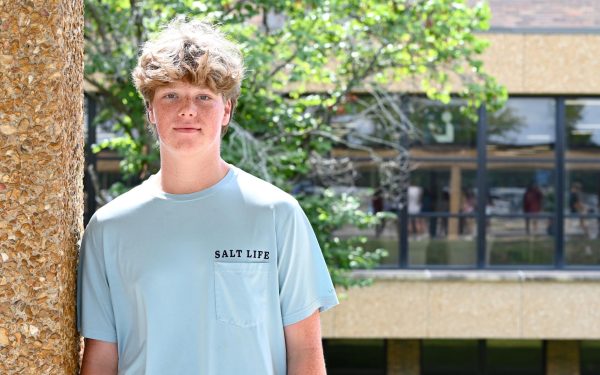
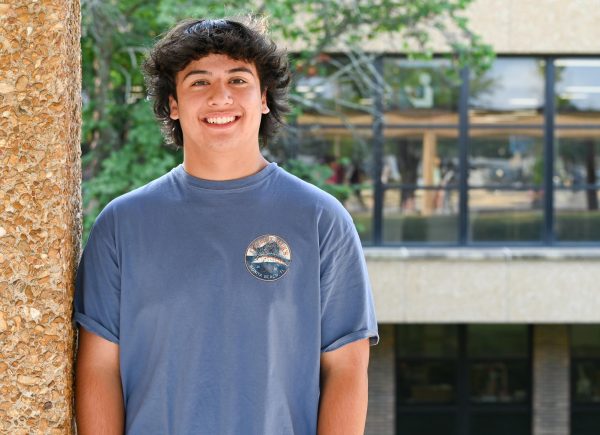
Junior Sam Mouser: I’m Sam.
Junior Ryder Williams: And I’m Ryder.
Mouser: And this is Athletes of West.
Williams: Today, we had the chance to talk to senior varsity track and field runner Alexander Berryhill Jr. about his transition from baseball to track.
Williams: When did you first start playing baseball, and what got you into it?
Senior Alexander Berryhill Jr.: I first started playing baseball when I was about 10 years old. Then I quit for a while, but I got back into it freshman through junior year. What got me into it was just having fun in the field and making plays with all my other friends, and also being able to play catch with my dad sometimes. When we would go to the batting cages, it was always fun.
Mouser: What position did you play, and what would you say is the most enjoyable part of the game?
Berryhill: I played center field, and I think the most enjoyable part of the game was definitely tracking down fly balls. It was always a mix of shallow balls and deep balls, [and] you never really knew what to expect, so I feel like that aspect really brought me back into thinking I never know what I’m going to see next. Being able to make those catches in the outfield was always something that brought me joy in the game.
Williams: With your time playing baseball, what is a memory you’re never going to forget?
Berryhill: A memory I’m never going to forget is definitely the bus rides to the games. It’s not necessarily about the game itself, but it’s about how the team was on the way to the games and from the games, no matter what. We always were laughing and talking about things before the game. It was never just a dull bus ride. There was always something going on around us, and we just never let the moment die.
Mouser: Can you walk me through what happened with your injury?
Berryhill: It was our second-to-last game against Francis Howell North, and I was in center field. Someone hit a very shallow ball into the field. I didn’t give up on the play; I just continued to run super fast to make the catch. As I was sliding to make the catch, I was bracing myself, and I heard two loud cracks in my shoulder. It wasn’t until after that [that] I felt the pain. It was really bad, but I still made two plays until my coach finally realized that I was in pain. And then he pulled me. And then later that day, I went to urgent care, and I found out that I tore my shoulder labrum, and I also dislocated my shoulder, but it relocated in the same slide. It was a very bad process because it did end my baseball career, so I couldn’t play my senior year.
Williams: So you needed surgery, correct?
Berryhill: Yes, I did.
Williams: How did you feel when you found out you needed surgery?
Berryhill: They told me that if I got the surgery, it would definitely be a long process, and I probably would not be able to play baseball again after it because of the recovery process. It would have taken about six months, but I decided I would still go through with the surgery because I realized if I didn’t go through with the surgery, my shoulder labrum would still be torn, and it would still be bad later in life. So I decided I would get the surgery even though I knew it would be a very tragic, career-ending surgery.
Mouser: What was the hardest part for you during recovery?
Berryhill: Definitely [being] stuck inside — not being able to do anything — and I was in a sling, so I couldn’t do physical activity at all for a long time. That really killed me inside because I like to be physical and go outside and do things. When I couldn’t do that, it made me realize that this is actually really serious and I had to be careful going forward with all of this.
Williams: Did you ever doubt at one point that you would never be able to return to a sport or any sport at all?
Berryhill: I did at one point, yes, only because the pain was pretty bad, and, with the way the surgery was, it limited my range of movement, so I couldn’t move my shoulder super far behind me, or I couldn’t move it the right way because it would just start hurting.
Mouser: What made you decide to give track a try?
Berryhill: All my siblings and my family wanted me to give it a try before I even started playing baseball — but I still played baseball. Also, my other friends wanted me to run track, so I decided I would give it a try since I [knew] I [wouldn’t] be able to play baseball. I would do track because I was already fast enough without track, so I felt, if I was fast like that, then I could definitely do track. I also [knew] it would make my family proud if I did that because all [of] my siblings ran track in high school, so it would keep the legacy up.
Williams: Was it difficult to move on from baseball?
Berryhill: It was a little bit, definitely. Mainly because, going into the track environment, I didn’t know that many people. With baseball, I already knew a lot of people, so having to switch from the baseball friend group to the track friend group was difficult. I had to figure out all the other people around me, and it was a slow process of getting used to everything.
Mouser: What were some other parts of track that made it different from baseball, besides not hitting a ball or the different friend group?
Berryhill: Definitely the fact that it’s all running. With baseball, we ran, but not as much as we do now in track. [In track], I went from a sport with just running 90 feet [to] bases and being able to sit down to running for an hour [or more] every single day at practice [without] any days off. Meets are very long, so it’s not like baseball with hour, 30-minute games [or] two-hour games. You get rest, but you barely get rest at the same time.
Williams: What’s been your biggest accomplishment so far with track?
Berryhill: Definitely making varsity [my] first year, and currently, I’m ranked first on the team for high jump and long jump, so that’s also really good. For my first year, I think this is a really big accomplishment [because] I’ve also been talking to this coach from Webster University, so I might look into that for running track in college as well.
Mouser: How has this experience changed you as an athlete or person?
Berryhill: It made me realize that I’m capable of way more than I think. With baseball, I thought I was just a good runner and a good outfielder, but track made me realize that I can do a lot more things that I put my mind to. [Because of] my asthma, I would get tired fast, but I conditioned myself better, so now I can run for extended periods. It helped me to see my full potential as an athlete.
Williams: Looking back, do you think everything happened for a reason?
Berryhill: Honestly, yes. After my shoulder injury, my sister told me it happened for a reason and that God has me. It made me realize that if the shoulder injury didn’t happen, I wouldn’t know how talented I [am] at track and the people I’ve met through track. [It also gave me] opportunities to talk with a college coach. It really made me realize that it definitely happened for a reason, and I am pretty proud of [who] I’ve become now and how I am [doing] with track and my performances overall.
Mouser: What would you say to someone else with an injury to help them get through it?
Berryhill: I would say definitely don’t give up. Even if you get [injured] in a sport you really like, don’t give up before you try something new. If you give up, you’ll never know the other opportunities you have in life. Going through an injury, it is difficult to have to give up certain things and having, for me, a limited range of movement is difficult, but once you overcome the issue and go through the recovery stage, everything slowly, progressively gets better. You realize that everything is okay, so you don’t really have to worry about it, and you just have to push through everything that goes on with your life.
Williams: Thank you.
Berryhill: You’re welcome.
Williams: Thank you for tuning into this episode of Athletes of West.
Mouser: And make sure to look for Alex on the varsity track and field team.
Music credit: Jetsonmade – “Rock the Boat” (full beat)

![Stepping up to the tee box, junior Connor Boles lines up his shot before teeing off on the first hole at the Ballwin Golf Course. The team took on the Northwest High School boys’ varsity golf team on Mar. 24. “Golf [is] a sport where I get to feel free; it takes everything off my mind for a couple of hours,” Boles said.](https://pwestpathfinder.com/wp-content/uploads/2026/04/DSC8040-e1776864425510-1200x792.jpg)


![In perfect shooting form and with eyes on the rim, junior Tyler Kuehl is about to shoot his next basket in the last game of the season against Marquette High School. Kuehl has been playing basketball since he was 5. “Even though I played basketball all my life, the game-winning shots can be pressure, it's confidence. If you're going into that shot and not thinking that you're gonna make it, it's obviously not going in. And if you believe, [it will]. That's the only way you can succeed,” Kuehl said.](https://pwestpathfinder.com/wp-content/uploads/2024/01/unnamed-32-1-1200x1200.png)
![Two of Pathfinder’s most recent editorial accolades shine on display in journalism teacher Lindsey Katz’s room. Pathfinder was recognized as a SNO Distinguished Site on April 24. “Praise isn’t everything, but it feels so nice to see the hard work of our staff recognized. So much more than just writing words on a page occurs [in journalism], and I am so glad people see that. I love being surrounded by such talented writers, but also such great people,” editor-in-chief and junior Payton Dean said.](https://pwestpathfinder.com/wp-content/uploads/2026/06/DSC_4941-1200x800.jpg)
![Takeout containers and boxes sit unused in the garage of senior Yein Ahn. Her family’s sushi restaurant, 153 Sushi, went out of business in March 2024. Like many restaurants, Ahn’s family experienced the struggle of the restaurant business amidst the lasting economic effects of the COVID-19 pandemic. Business teacher Andy Croley has been teaching his classes about these modern challenges restaurants face trying to adapt to the rapidly changing economy and market. “[The food industry is] super competitive. There are restaurants everywhere you go, so they have to figure out what niche they're going to fill. Then, just like us as consumers, right now at home, where our prices are going, prices [for restaurants] are continuously going up as well. Inflation would definitely be a factor for people as well, because with inflation, [restaurants] are also seeing rising costs in their lease or their rent, electricity and all across the board,” Croley said.](https://pwestpathfinder.com/wp-content/uploads/2026/05/DSC_0004-1200x800.jpeg)
![Eyes on the crossbar, sophomore Harrison Hughes prepares for his 12-foot jump. Hughes is in his second year of track, and recently cleared 13 feet in pole vaulting. “I had some shin splints going on, so I was a little bit worried [about this jump]. I’ve been pressing well, so I’m feeling good about the season,” Hughes said.](https://pwestpathfinder.com/wp-content/uploads/2026/04/DSC8099-1-1200x798.jpg)


![Coming together in a hug at the end of their performance, seniors Emma Callahan, Lila Kayser, and Lily Overmann are honored at the end of their senior night on Jan. 23. For Longhorn Line, a special part of senior night is performing a dance choreographed by the team's seniors, who have had a particularly successful 4 years of dance. “We won state for both of our dances last year, which was a huge accomplishment for us [as dancers], and the program. Longhorn Line has been such a big part of my life, giving me memories and friendships I’ll never forget,” Callahan said.](https://pwestpathfinder.com/wp-content/uploads/2026/01/DSC9003-1200x799.jpg)
![Reaching for a new color, junior Abby Tice works on her art in drawing club during AcLab. On Jan. 9, Tice was encouraged by her friends to attend her second meeting. “I’m not very much of an artist, but I get to see my friends in Drawing Club, and they support me. My favorite part is meeting new people, and I’m [glad] I’ve found an environment like this,” Tice said.](https://pwestpathfinder.com/wp-content/uploads/2026/01/DSC01363-1200x800.jpg)
![Wearing heavy Roman armor and holding a chief, senior Nick Cook talks to eighth graders about the Latin program at West High. Latin teacher Tom Herpel offered Cook the opportunity. “I had some of the students dressed up in tunics, [and Cook] was in Roman armor. I had them walking around giving flyers to people with general information about Latin, as well as allowing them to talk to kids and give a play-by-play of what we do in class,” Herpel said.](https://pwestpathfinder.com/wp-content/uploads/2025/12/DSC_5386-2-1200x800.jpg)