I fall victim to the typical affliction of high school bookworms: never having time to read. With volunteer hours, mountains of homework and after-school practices, there doesn’t seem to be a minute to pick up a text that’s not related to Honors Precalculus or AP European History. Still, what always seems to creep into my weekly schedule, even as I wage a failing mental battle against it, is a monstrous amount of screen time on TikTok.
Featuring videos of between three seconds and ten minutes in length, TikTok is a busy student’s dream, filling five-minute study breaks and feeding late-night insomnia with bursts of bright pixels that distract from the stress of a long day. My latest vice? True crime: a For You Page of whodunit mysteries and gruesome case updates dominated by 30-year-old women with podcast microphones. The more true crime I see, the more I’ve begun to feel slightly disgusted by it. Commentators recount each detail with an eerie enjoyment, characterizing victims and attackers alike in simple buzz words — headstrong, ruthless, clever — that elicit the most substantial reactions while discrediting the complexity of crimes. Still, I’m not the first to admit that these dramatized depictions keep me hooked. Tales of shock and gore not only foster disgust, but intrigue: the thrill of hearing each detail, daring audiences to keep listening.
Finally, I decided enough was enough. Picking up “The Secret History” was my attempt to return to ancient texts; that is, anything read from a piece of paper instead of my iPhone. The novel, written by Donna Tartt in 1992, has been deemed a budding classic, receiving immediate praise from The New York Times and becoming a No. 1 bestseller soon after its publication.
More recently, “The Secret History” was credited with inventing the dark academia aesthetic, which emphasizes moody color palettes and romanticizes classical Western education. This style attained broad popularity during the COVID-19 pandemic, and since then, I have seen countless articles and videos praising Tartt’s writing. Still, her work never really caught my eye until I watched a YouTube review by Jack Edwards, a seasoned book critic who recently covered the “Wuthering Heights” premiere in the U.K. Confident in his superior taste, I decided a little Ancient Greek and 1980s college life was just what I needed to tug me from my TikTok-induced stupor. I purchased a copy at my local Barnes and Noble and settled in.
Opening
With the first striking line, Tartt sets the scene for a mystery not of plot, but of motivation. While she establishes early on that the character called Bunny is murdered, Bunny remains alive through the first half of the novel, meaning Tartt must use her own gift for language to keep audiences in anticipation for several hundred pages.
As the pages flew by, it became clear that “The Secret History” is a masterclass in compelling writing, each paragraph written in a shockingly dark, hauntingly beautiful prose that made me question why I’ve ever bothered even writing a paragraph. Tartt has a gift for describing commonplace nouns in ways that make her words seem new. The nighttime is “black and gusty and enormous,” hilltops are “velvety swell of land” and murder is simply “the redistribution of matter.”
Tartt’s writing proves not only grandiose and distinct but astonishingly well-researched: the text contains multiple languages and references to at least 92 other works of literature. Accordingly, I feel it’s critical to mention that “The Secret History” is far from a quick and easy read (for those looking for lighthearted fun, check out these romance novel suggestions). With around 600 pages of complex, dense text and an erratic plot, I never would’ve finished this book had it not been for the uninterrupted hours of reading in bed over winter break.
Plot
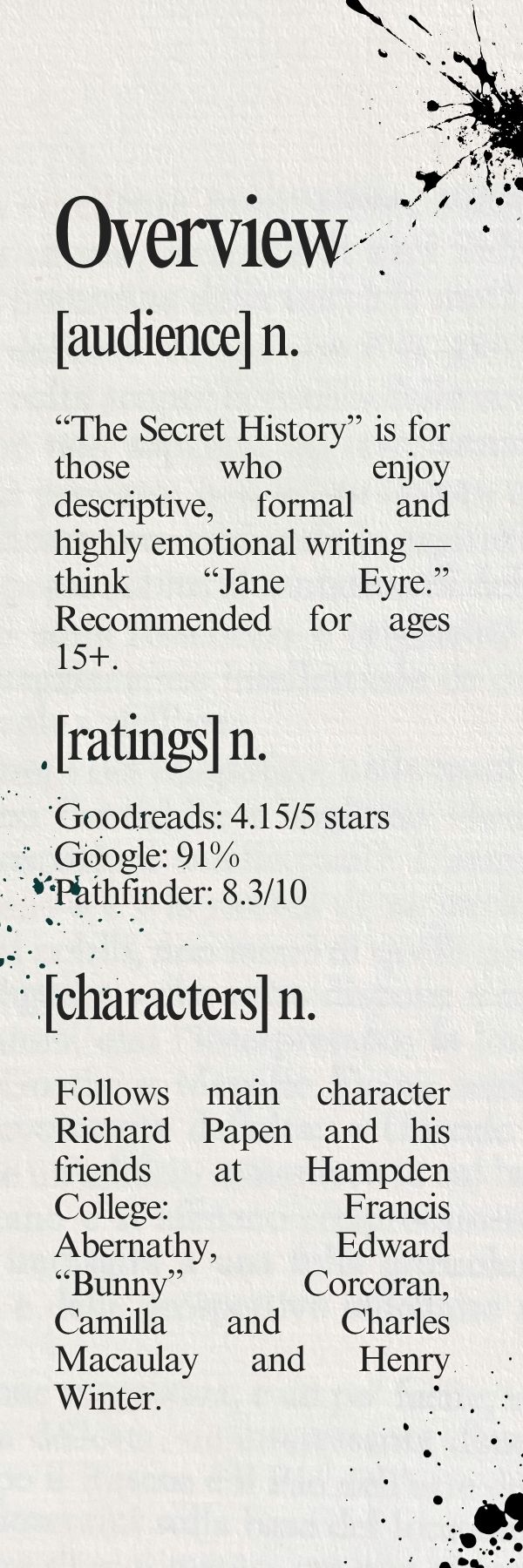
The story line follows a young narrator named Richard Papen as he abandons small-town California to attend Hampden College in Vermont. There, he enrolls in the Classics program, a tight-knit clique of five students: Francis Abernathy, Edmund “Bunny” Corcoran, Charles and Camilla Macaulay and Henry Winter. Under the eye of enigmatic professor Julian Morrow, the class’s affinity for Greek culture morphs into an obsession — first leading to the killing of a farmer and eventually the betrayal and murder of their own Bunny Corcoran. Along the way, Papen floats between life with the group and other connections at Hampden; he interns in a dusty office, nearly freezes to death in a warehouse and listens to Lynyrd Skynyrd’s “Free Bird” with my personal favorite character, the gossipy fellow Californian Judy Poovey. Richard confesses his role in Bunny’s death in the prologue, setting up the first half of the novel as a fast-paced deep dive into the events leading up to the murder.
On the other hand, the less plot-dense second half of the novel is where critics tend to find fault. It presents itself as a tedious unraveling of long-standing trust and friendship as each student confronts — or avoids facing — their role in Bunny’s death.
Quite frankly, I enjoyed it a lot. I have a soft spot for drawn-out, dramatized scenes where nothing plot-significant happens, like when Richard spends ten pages grabbing a glass of water. However, I’ll acknowledge the average sci-fi reader may begin to die of boredom around this point in the story. Additionally, the gorgeous writing does not excuse the amount of half-baked side plots Tartt never commits to, such as the single page of clear incest between Charles and Camilla (which is never explained in the slightest) or the ease with which the group evades blame for Bunny’s death. Personally, these fallacies didn’t ruin the intrigue of the book, but they definitely left me confused as a reader.
Criticism
Nonetheless, one of the biggest criticisms I see to “The Secret History” is also one of the most unfounded. Numerous reviews claim that while the dialogue and interactions in the novel are quite natural, characters aren’t given much depth beyond a surface level. I find this to be absolutely correct. Richard’s descriptions of each character center around only a few basic traits — Bunny is boisterous and clueless, while Camilla is beautiful and steadfast — and readers are left to infer their deeper desires, motivations and fears without many clues.
While some see it as a weakness, I believe Tartt’s depiction of Richard as an unreliable narrator is deft. The first chapter of “The Secret History” opens with the line, “Does such a thing as ‘the fatal flaw,’ that showy dark crack running down the middle of a life, exist outside literature? I used to think it didn’t. Now I think it does. And I think that mine is this: a morbid longing for the picturesque at all costs.”
Richard, who spent his childhood in the mundane town of Plano, Calif., didn’t seek out Hampden College for its educational value. Enticed by a brochure, he was enamored with the sophistication of the idyllic New England campus. At Hampden, Richard joined the Greek class not to foster his love of the ancient language, but to associate himself with its beautiful, rich students. Even as he learned that they had committed the murder of a farmer and planned to flee the country, he did not for a second consider giving up the sense of prestige and class their friendship allowed him by turning them in. In fact, he was even complicit in the murder of his close friend, Bunny, after the Greek class determined he must be disposed of.
To put it briefly, everything Richard does is in search of beauty, class and a higher plane of being than his bleak youth. This obsession continues through his narrative seven years in the future. Deeply detached from his old companions and struggling with the trauma and lifelong guilt he carries after Bunny’s death, Richard describes their personalities in the simplified way he remembers them: as beautiful, fascinating beings. Richard is aware that this reverence is his “fatal flaw,” yet does nothing to mitigate it, reinforcing the idea that his fixation on romanticization will always overshadow the accuracy of his accounts.
Oddly, this aspect of the book seems to prove that the time I spend on social media versus reading literature is not so different; Richard’s attitude towards horrid crime bears a shocking resemblance to the way we treat it today. On TikTok, true crime is the No. 3 most popular genre of video podcast, exhibiting how gruesome stories of death and deceit can be made enjoyable and addictive (such as the online frenzy that occurred this April over a new suspect in the “Lovers’ Lane” murders and the ongoing disappearance of Nancy Guthrie).
In order to do so, the shows and podcasts worshiped by countless high school students often profit off of tragic events to produce cheap entertainment. Richard, in his quest for the picturesque in ignorance of all consequences, treats Bunny’s death with near-reverence despite the pain it has caused the victim’s family. Similarly, the loved ones of real-life victims are often exploited by the true grime genre, forced to stand by as their trauma is glamorized. In the end, both repackage intricate situations of sudden loss as one-dimensional accounts void of true sympathy or understanding. As such, I found “The Secret History” not a story of crime as much as a look into how we view it in society, making Richard’s narration much more lifelike than Tartt is credited for.
Final thoughts
All in all, I wouldn’t say “The Secret History” is something that should be found on a “100 Books to Read Before You Die” list, as it so often is. It’s a masterfully crafted, elegant novel that immerses you in the world of Hampden, Vt. while giving readers a glimpse into the global attitude of today’s online Earth, but it’s not for everyone. The plot feels dull at times, the lack of character depth fails to entice some readers and flowery language turns others away. Still, I really enjoyed this book; to me, Richard’s reverence for the elitism of his group over the authenticity of his narrative made for a unique reading experience that I feel accurately mirrors human perception.
Overall, this book was one of the best I’ve read throughout high school, and it’s a novel I’ll think about for years to come. Accordingly, Pathfinder gives “The Secret History” by Donna Tartt an 8.3/10.


![Pantone’s choice for the 2026 Color of the Year is revealed: Cloud Dancer. Art teacher Kristi Ponder has studied the psychology of colors, which she incorporates in her lessons. “[White as a blank space] is a very interesting way to think about it. I actually like it a lot more now that [it’s] phrased that way, where it's like the possibilities are endless. You can pair [Cloud Dancer] with anything. To me, that could be a connection that they're trying to make [about] where we're at as a society right now. Where are we moving next? What's going to happen next? And we don't really know,” Ponder said.](https://pwestpathfinder.com/wp-content/uploads/2026/02/DSC_0008-1-1200x800.jpg)
![Surrounded by the crowd, sophomores Chloe Reis and Annie Upchurch get ready for Ty Myers to start playing on Jan. 22. Reis and Upchurch have been fans of Myers since his last album, so they decided that they couldn’t miss out on the concert. “ I [think it’s] so impressive that he is only 18 years old and already has a successful career, so I wanted to see that in person,” Reis said.](https://pwestpathfinder.com/wp-content/uploads/2026/02/usethis-1200x900.jpg)