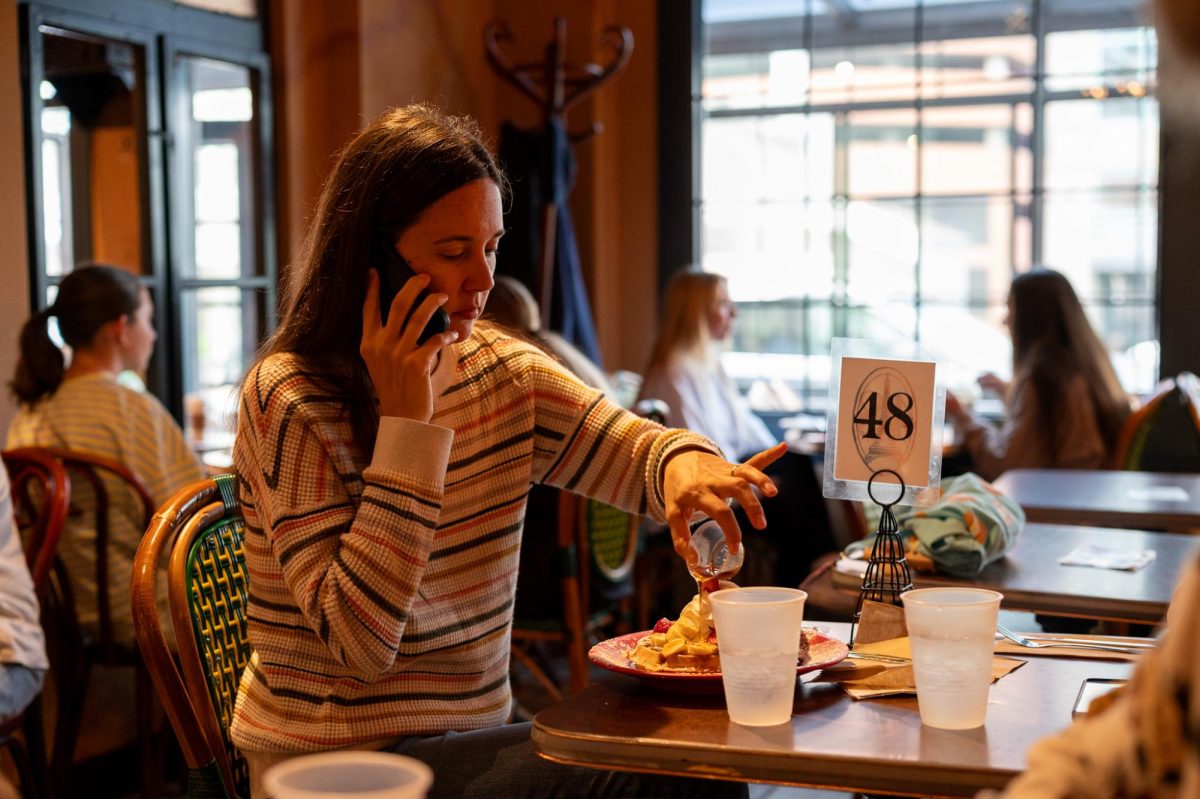
![French teacher Blair Hopkins enters City Coffee & Creperie in Clayton, Mo. for breakfast with her Honors French 4 students and AP French 5 students. Both classes went on a field trip to a fair trade chocolate factory in St. Louis to begin their unit on Côte D’Ivoire, a major producer of cocoa beans. “My ideal school would just be the Magic School Bus — you would always learn about things by going someplace and learning hands-on, being able to see it yourself and asking people questions. I think [learning is] always so much more memorable if you can experience it firsthand,” Hopkins said.](https://pwestpathfinder.com/wp-content/uploads/2026/05/DSC2795-1200x798.jpg)
Throughout the month of April, students enrolled in French 1, French 3, Honors French 4 and AP French 5 all went on separate field trips to enhance their learning and develop their cultural awareness. From a chocolate factory to an art museum, French students traveled across the St. Louis metropolitan area and gained new, unique experiences, tied to the city’s French history.
Honors French 4 and AP French 5
On April 2, after stopping at City Coffee & Creperie for breakfast, Honors French 4 students and AP French 5 students toured Chocolate Chocolate Chocolate Company, a fair trade chocolate factory on the Hill.
“This year, we’re reading a graphic novel called ‘Aya de Yopougon’ that takes place in Côte d’Ivoire in Western Africa. That’s the only time we learn about Côte d’Ivoire, so I really want [students] to learn more about the cultural context,” French teacher Blair Hopkins said. “In rural Côte d’Ivoire, cacao plantations are a huge part of life and one of the biggest exports, so we go to the chocolate factory because they use fair trade beans from Côte d’Ivoire.”
Responsible for about 45%, Côte d’Ivoire is the world’s largest producer of cocoa beans by far. However, for many Ivorian farmers the unstable nature of commodity prices often results in unpaid wages and poverty. To combat this inequality, all of the cocoa beans Chocolate Chocolate Chocolate Company uses to produce chocolate are ethically sourced, so Ivorian farmers can benefit from stable prices, safer working conditions and premiums for community development.
“We’re learning about Côte d’Ivoire right now, [which is] a major producer of chocolate in the world. We’re learning about how [cocoa beans are] harvested there, so it’s really cool to see how something that comes from a place that is so far from us is incorporated into somewhere so close to home,” senior Sophie McCarthy said.
At the chocolate factory, students had the opportunity to tour the facility and see firsthand how chocolate is made, from the facility’s enrobers that apply chocolate coating to hand decoration by the chocolatiers. Students also learned about the history of the factory: originally, the factory belonged to Bissinger’s Handcrafted Chocolatier. Bissinger’s was founded in Paris in 1668 and was bestowed the title of “Confiseur Imperial” (Confectioner to the Empire) by King Louis XIV. Eventually, Karl Bissinger moved the company to the United States in 1845, and Karl Bissinger Jr. moved it to St. Louis in 1927. In 2019, Bissinger’s was acquired by Chocolate Chocolate Chocolate Company, a St. Louis company founded in 1981. Both companies now belong to the Abel family, the founders of Chocolate Chocolate Chocolate Company, and though operating in the same facility, they maintain their distinct brands.
Because Honors French 4 and AP French 5 are a combined class, Hopkins alternates between curricula every school year. Next year, the French 4 and 5 field trip will be to the Saint Louis Art Museum for a unit on art repatriation.
French 1
On April 10, French 1 students traveled to La Bonne Bouchée in Creve Coeur, Mo. There, students practiced their French vocabulary and taste-tested traditional French recipes. Joined by her students, French teacher Karen Craddock has been frequenting the restaurant for years.
“I think I started going when I was teaching middle school. We’ve always had a cafe unit, and it’s just a wonderful experience. When the original owner was alive, he would sometimes come to the table and speak with us so we could practice our French. Since he’s passed, we don’t really get that opportunity [anymore], but the menu stayed the same,” Craddock said.
The former owner, Olivier Leguet, was a French pastry chef who owned La Bonne Bouchée for 20 years until his death in 2022. Still, his memory lived on with his loyal customers and in the restaurant’s recipes.
“[My goal for the trip was] that [students] could experience what it’s like to actually eat French food. The owner taught his family members the traditions, and they’re keeping things going. I think it’s a pretty authentic French cafe experience,” Craddock said.
Additionally, students practiced navigating the “formule,” a French cafe staple. A formule is a multi-course meal that students can customize and buy for a fixed price, offering a price discount for Craddock and her class.
“I ordered [the] bouchée de légumes, [a vegetable dish]. I’m Muslim, so I can’t really eat a lot of meat. Also, I like quiches, I like vegetables, so vegetable quiche — two things I like. One of my favorite [memories was] everyone just getting their food and being happy,” freshman Wafi Rahaman said.
Although Leguet could no longer practice French with the students, during the meal, a different community member approached the table and began speaking French.
“I’d say [field trips] are very important as they include very optimized learning moments. A parent [of a] teacher from [West] Middle came by and started asking us questions in French. No one else knew how to answer them properly, so I had to clutch up and [save us],” freshman Nate Bueg said.
Whether students were saying “merci” and “bonjour” to the bus driver or practicing with the “formule,” the cafe field trip helped students learn through its connections to the curriculum, the culture and the community.
“I was so proud that he spoke in French. I was also proud because I learned [one student] was not given her food, and she was just very patient with the server. I was proud of all my students. Everybody sat at the table together, and no one was excluded,” Craddock said.
On the whole, the French 1 field trip to La Bonne Bouchée inspired students to make real-world connections, expand their learning and apply their knowledge through unique interactions.
“I believe field trips are very important for the learning experience. [We have a] very diverse school, but it’s [still] a very small environment, so we go out in the open, and we learn so many different things. I feel like that’s really crucial for [our learning],” Rahaman said
Every year, Craddock asks her students if the field trip was worth it and if she should continue offering it next year. Every year, the answer is the same.
French 3
Finally, on April 15, French 3 took their annual trip to the Saint Louis Art Museum. Like Honors French 4 and AP French 5, French 3 also stopped at City Coffee & Creperie on the way to their destination.
“For French 3, they have an entire unit before they go to the art museum that’s about ‘patrimoine,’ which is the concept of cultural heritage. Mainly, we learn about the 18,000-year-old cave paintings in the southwest of France in Lascaux and the architecture of Notre Dame and other Gothic cathedrals that are pretty unique to France. Then, I give them an overview of highlights of famous French paintings, and [students] pick a couple they want to research in depth,” Hopkins said.
After research, students traveled to the art museum and had the chance to reflect on various Francophone artworks, comparing what they had learned to historic paintings and sculptures. The museum encouraged students to peer into the many different cultures and perspectives united by a common language.
“The unit we were in at the time [looked] at the history of art throughout the French-speaking world,” sophomore Srinidhi Sripada said. “We went on a scavenger hunt at the art museum, where [Hopkins] would give us a list of exhibits to see and a way to confirm we went there. It was really fun, and I think I got to take a look at some of the more influential pieces of French culture.”
To complete the scavenger hunt, students had to complete challenges to confirm their findings.
“There were a couple of groups that were so proud that they found every single thing on their list, so I really liked seeing that they were invested in it. [One] of the challenges they had to do [was] find this hand-carved canoe from New Caledonia, and someone had to sing the first part of ‘How Far I’ll Go’ in front of it, take a video and show it to me. [Other] challenges were like, ‘one of you has to act out this painting,’ or ‘stand in the same posture,’” Hopkins said. “It’s pretty hilarious at the end when [students are] proud of what they’ve found and I get to see all the goofy pictures.”
The trip to the art museum extended students’ learning beyond the classroom and cultivated an environment where students could seek to understand the distinct experiences of the Francophone world.
“That was [my first time at] the art museum, and I think it’s really cool [we] have a free, fun place to experience all this stuff,” Sripada said. “A lot of stuff [tied] directly to our unit too, so [we could see] it in the real world. If you’re able to tie [field trips] to something in the community, it makes it more impactful, and it sticks more.”
In 1764, St. Louis, originally a French fur trading post, was founded by Pierre Laclède and Auguste Chouteau. The city was named after King Louis IX of France. The flag of St. Louis, adopted in 1964, contains a fleur-de-lis, representing the city’s French roots. No matter where you look, there is no shortage of French heritage in the St. Louis community. Similarly, there is no shortage of opportunities for West students to connect with French culture.
“In the St. Louis area, it is so easy to find French things. There’s the Festival of Nations, there’s the [Robert] French Film Festival, there’s La Bonne Bouchée, there’s TOUS les JOURS; there [are] so many different French things that we can take advantage of,” Hopkins said. “I always want my students to know that all of this is out there for them to experience if they want to.”
![Setting up the activity for his first meeting, Financial Literacy Club founder and sophomore Yash Bandiananthaiah writes on the whiteboard. For the first meeting, Bandiananthaiah created an interactive experience for members to immerse themselves in. “To me, the most important thing during a meeting is to make sure we are all engaged and participating, and [I do this by] always making sure we have a hands-on activity,” Bandiananthaiah said.](https://pwestpathfinder.com/wp-content/uploads/2026/05/DSC5306-1200x798.jpg)
![Dressed in the traditional uniform of the US Air Force, sophomore Eric Thomas stands in front of the US flag. Thomas joined Civil Air Patrol on Jan. 14, 2024, and has since risen rapidly through the ranks. He is currently at the position of Chief Master Sergeant. “Not everybody gets a chance to wear a uniform as prestigious as [the] United States Air Forces[‘]. Having the ability to wear it is truly an honor, [because] it lets me represent some of the core values that I am required to uphold while in the program," Thomas said.](https://pwestpathfinder.com/wp-content/uploads/2026/04/DSC_0003-1200x798.jpg)
![Smiling at her teammates, freshman Angela Diosdado works on her state robot. As a freshman and mechanic for the robotics team, the Blue Brains, Diosdado’s dedication has already been contributing to the team’s success. “[State] was really fun and we did pretty good, [but now] we really have to focus on Worlds. I know that our teamwork and [the fact that we have each other’s backs] will make [our goals] happen,” Diosdado said.](https://pwestpathfinder.com/wp-content/uploads/2026/04/DSC_4717-Enhanced-NR-1200x800.jpg)
![Senior Michael Collop stands in the sun at Vlasis Park in Ballwin, Mo. Collop has earned each of the 142 merit badges currently offered by Scouting America, joining the estimated 650 other Scouts who have done the same. Out of roughly 130 million youth who have participated in Scouting, only 0.00077% have achieved this distinction. “The whole point of merit badges is to learn something from them and get a glimpse into every single career or every aspect of [Scouting]. I think I took something from each one of those merit badges that's [going to] be with me for the rest of my life,” Collop said.](https://pwestpathfinder.com/wp-content/uploads/2026/04/DSC7392-1200x798.jpg)
![Twinkling lights glow in homes and neighborhoods as families decorate to celebrate Ramadan and welcome in Eid. Junior Zainab Aljaff reflects on how this holy month shaped her, and how these values continue beyond the holiday. “Eid helps me realize that the things we learn during Ramadan is beyond [the] month. Eid is so exciting because it is a reward for everything that we worked on [during] Ramadan. Being able to share the day with my family made it unforgettable,” Aljaff said.](https://pwestpathfinder.com/wp-content/uploads/2026/03/Screenshot-2026-03-30-at-8.38.05-AM-1200x792.png)