

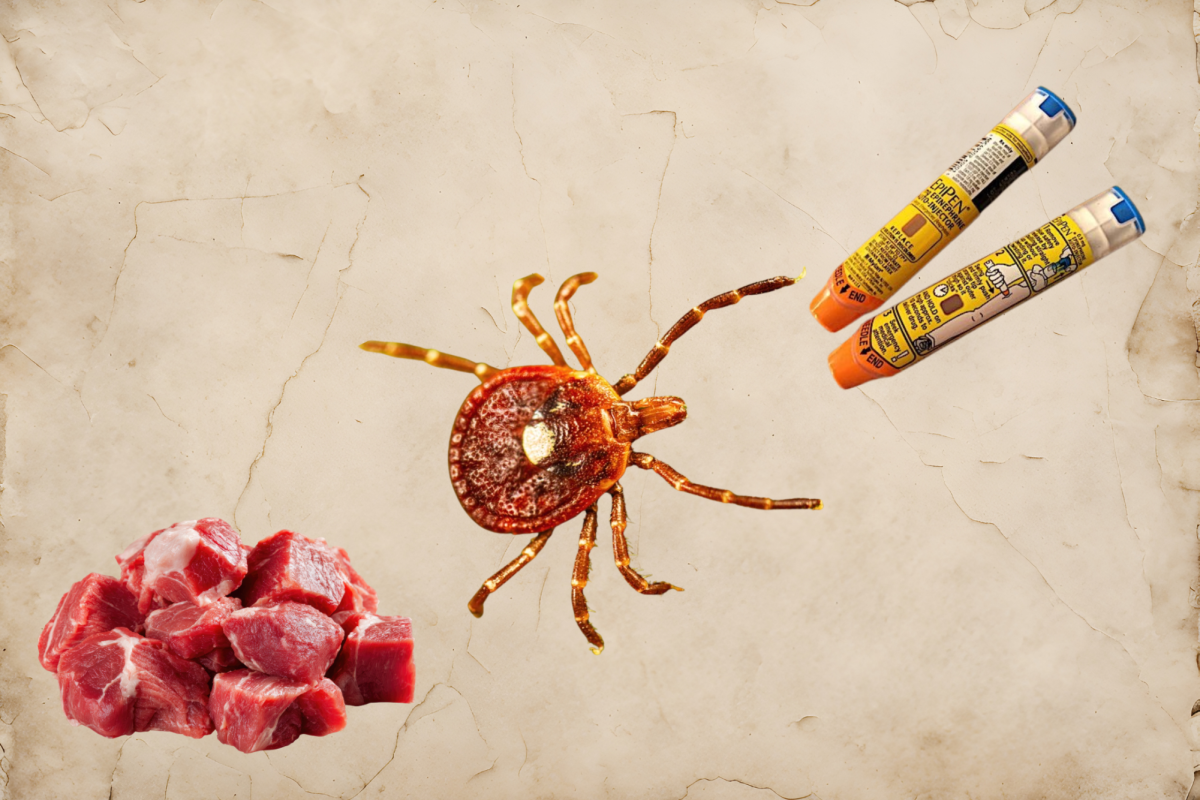
On June 17, I was at S Bar F Scout Ranch, just south of Farmington, Mo., attending my Boy Scout troop’s annual summer camp. Something bound to happen to anyone out in the woods is a tick bite. It is nearly impossible to spot a tick before it drops onto you, as they lie waiting in the trees and brush, waiting for someone to pass by. By the time you feel the tick on you, it has likely already bitten into the skin. I only noticed the tick after it had buried itself into my left wrist.
For months, I had no adverse reaction to the tick bite. This changed mid-November 2025. I had a burger for dinner, did my homework and went to bed. To me, it was a completely normal night. By 11:30 p.m., I was in the emergency room with severe anaphylaxis, a systemic reaction to what the immune system sees as a foreign body. I had no idea that a burger had caused this reaction. After blood tests, I came back positive for an allergy to the sugar galactose-α-1,3-galactose, and I was officially allergic to red meat.
Currently, Missouri ranks among the states with the most cases of AGS. This condition is affecting an estimated 450,000 people in the U.S., and an estimated 34,000 people have AGS in Missouri alone.
Causes
The allergy to galactose-α-1,3-galactose, commonly known as alpha galactose syndrome (AGS) or alpha-gal, is caused by a tick bite. When bit by a tick, the tick buries its head into the skin and uses its saliva to draw blood to its mouth. The lone star tick is the primary tick species in the U.S that carries galactose-α-1,3-galactose in its saliva.
“It’s an allergic reaction [to] the alpha-gal is, [which is] a kind of galactose. This kind of galactose [is one] that our body doesn’t recognize. It’s something that we don’t produce, so when [a] tick bites you and injects a small amount of this galactose into your blood, your body responds with an allergic reaction [and] starts secreting immunoglobulins that trigger this immune response,” biology and AP Environmental Science teacher Paul Hage said.
The reason people then develop an allergy to red meat is because nearly all mammalian species, except for humans, have the alpha-gal sugar in their meat. Because the body is producing antibodies against alpha-gal when it is consumed through mammalian meat, the body can have a range of reactions. Unfortunately, there are more allergens than just red meat. Any mammalian by-product such as gelatin, dairy products, lard and tallow can cause a reaction. The meat from fish and birds is safe to eat for those with AGS.
“We can actually eat [alpha-gal]. We can break it down, we can digest it, but we can’t have it go directly in our blood, which is what’s happening [with a tick bite]. That’s the difference. So when a tick bites you [and] injects [alpha-gal] directly in your bloodstream, that’s viewed as a foreign body, and it’s not broken down,” Hage said.
The lone star tick is not the only species of tick that causes AGS. In Europe, the castor bean tick carries the sugar, and in Australia, the Australian paralysis tick is the primary culprit. In the U.S, the blacklegged tick is becoming another prevalent source for the alpha-gal allergy, where in a CDC study they were found to cause 9% of AGS cases. Furthermore, these U.S tick species are spreading to new states every year.
“With climate change, you have shorter winter seasons and you have higher survivability of ticks and then a longer breeding season for lone star ticks. So their range is expanded because there [are] more places that can support them,” Hage said.
More than that, even deer and urban sprawl contribute to the rise in ticks and tick bites.
“[Ticks thrive in] environments where deer are. Another contribution to their spread is that we have a lot of [urban] sprawl. So you have a lot of cities that are moving into forested areas or wild areas where unmanaged deer herds are. If the deer herds get too big, your incidents of tick bites go up. So it’s all about climate change. It’s expanding range. It’s suburban sprawl into wild areas. It’s uncontrolled deer herds,” Hage said.
Effects
The symptoms caused by an alpha-gal allergy can have a range of effects. In less extreme cases, symptoms can include stomach and gastrointestinal issues, nausea and vomiting. On the more severe side, consuming alpha-gal can lead to an anaphylactic reaction, with symptoms of hives, rashes and respiratory issues.
These effects happen between two and six hours after the consumption of the allergen, making it difficult to identify what the cause was. The allergy can lie dormant for up to three months after the initial bite.
Furthermore, the severity of the reaction is not consistent between people with alpha-gal, as some people may be able to have dairy and some may not, or some people may have a severe allergic reaction to one product and not another. The only consistent correlation between a food item and the reaction severity is the fat content of the food. This is because the alpha-gal sugar is contained in the fat of the animal.
Prevention
There is only one way to prevent AGS, which is to prevent tick bites. These are a few ways to help lower the risk for tick bites.
- Treat clothes and shoes with permethrin, a bug repellent.
- Avoid bushy, grassy areas that do not have a clear trail. Ticks thrive in these areas.
- Use strong bug spray such as deet, picardin or eucalyptus.
After a day outside, it is also crucial that you check yourself, others and pets for ticks. Ticks are attracted to warm areas, so check those first. Even if you did not get bit, ticks can still hitch a ride on your clothes, so a 10-minute round in the dryer at high heat will get rid of any remaining ticks.
If you do find a tick bite, it is crucial that you act quickly to lower the risk of an adverse reaction. Use tweezers to grab the tick as far down the head as possible to ensure that the head of the tick does not stay in the skin. If you begin to experience any of the symptoms above, the CDC recommends you consult a doctor. Furthermore, if you take a photo of the tick, this can help healthcare providers to assess any disease or sickness risk. For the lone star tick in particular, they can be identified by a small white dot on their abdomen.
Currently, there is no treatment for AGS. However, the sensitivity to alpha-gal can lower over time given that there is not another exposure to a tick with alpha-gal.
Awareness
Despite Missouri having some of the highest rates of AGS in the nation according to the CDC, a shocking number of people don’t know about this condition. After I was diagnosed, almost all of my friends and family did not know that it was possible to be allergic to red meat from just a tick bite.
In a CDC survey, a shocking 42% of healthcare providers did not know about alpha-gal and another 35% were not confident that they could diagnose the issue.
“I think that people have heard [of alpha-gal briefly in] conversation. [However], I don’t think most people really know anything about it [or that] they can explain how it works [or] that they can explain the effects of it,” Hage said.
At the moment, the best protection is prevention. Check yourself carefully after time outdoors and be prepared with bug repellents. If symptoms appear, consult a doctor about testing for an alpha-gal allergy.
The challenges that come with the condition are hard to neglect. As someone who has preexisting food allergies, I was prepared with the right tools when I had my first reaction. But for many, this is their first allergic reaction in their life. Furthermore, it is a challenge to adjust to a completely different diet. Cutting out foods many have enjoyed for their entire lives is one of the hardest things to do. Learning to identify what foods may contain an allergen that triggers AGS is even more challenging, as food packaging does not contain warnings like it might with gluten or nuts.
A tick bite is easy to dismiss. It’s small, often painless and is usually forgotten within days. Most of the time, nothing happens immediately. But months later, something does. Alpha-gal syndrome doesn’t begin with a dramatic warning. It begins quietly on a hike or camping trip in the woods. That’s why awareness matters. Something as small as a tick can have lasting effects, but with prevention and early recognition, the risk doesn’t have to follow someone home from the trail.
![Setting up the activity for his first meeting, Financial Literacy Club founder and sophomore Yash Bandiananthaiah writes on the whiteboard. For the first meeting, Bandiananthaiah created an interactive experience for members to immerse themselves in. “To me, the most important thing during a meeting is to make sure we are all engaged and participating, and [I do this by] always making sure we have a hands-on activity,” Bandiananthaiah said.](https://pwestpathfinder.com/wp-content/uploads/2026/05/DSC5306-1200x798.jpg)
![French teacher Blair Hopkins enters City Coffee & Creperie in Clayton, Mo. for breakfast with her Honors French 4 students and AP French 5 students. Both classes went on a field trip to a fair trade chocolate factory in St. Louis to begin their unit on Côte D’Ivoire, a major producer of cocoa beans. “My ideal school would just be the Magic School Bus — you would always learn about things by going someplace and learning hands-on, being able to see it yourself and asking people questions. I think [learning is] always so much more memorable if you can experience it firsthand,” Hopkins said.](https://pwestpathfinder.com/wp-content/uploads/2026/05/DSC2795-1200x798.jpg)



![Dressed in the traditional uniform of the US Air Force, sophomore Eric Thomas stands in front of the US flag. Thomas joined Civil Air Patrol on Jan. 14, 2024, and has since risen rapidly through the ranks. He is currently at the position of Chief Master Sergeant. “Not everybody gets a chance to wear a uniform as prestigious as [the] United States Air Forces[‘]. Having the ability to wear it is truly an honor, [because] it lets me represent some of the core values that I am required to uphold while in the program," Thomas said.](https://pwestpathfinder.com/wp-content/uploads/2026/04/DSC_0003-1200x798.jpg)
![Smiling at her teammates, freshman Angela Diosdado works on her state robot. As a freshman and mechanic for the robotics team, the Blue Brains, Diosdado’s dedication has already been contributing to the team’s success. “[State] was really fun and we did pretty good, [but now] we really have to focus on Worlds. I know that our teamwork and [the fact that we have each other’s backs] will make [our goals] happen,” Diosdado said.](https://pwestpathfinder.com/wp-content/uploads/2026/04/DSC_4717-Enhanced-NR-1200x800.jpg)
![Senior Michael Collop stands in the sun at Vlasis Park in Ballwin, Mo. Collop has earned each of the 142 merit badges currently offered by Scouting America, joining the estimated 650 other Scouts who have done the same. Out of roughly 130 million youth who have participated in Scouting, only 0.00077% have achieved this distinction. “The whole point of merit badges is to learn something from them and get a glimpse into every single career or every aspect of [Scouting]. I think I took something from each one of those merit badges that's [going to] be with me for the rest of my life,” Collop said.](https://pwestpathfinder.com/wp-content/uploads/2026/04/DSC7392-1200x798.jpg)
![Twinkling lights glow in homes and neighborhoods as families decorate to celebrate Ramadan and welcome in Eid. Junior Zainab Aljaff reflects on how this holy month shaped her, and how these values continue beyond the holiday. “Eid helps me realize that the things we learn during Ramadan is beyond [the] month. Eid is so exciting because it is a reward for everything that we worked on [during] Ramadan. Being able to share the day with my family made it unforgettable,” Aljaff said.](https://pwestpathfinder.com/wp-content/uploads/2026/03/Screenshot-2026-03-30-at-8.38.05-AM-1200x792.png)


Daniel • Mar 11, 2026 at 12:06 pm
Very well written article Max!