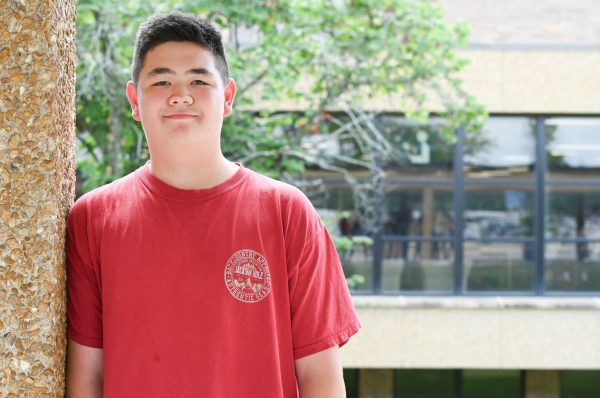

![Senior Michael Collop stands in the sun at Vlasis Park in Ballwin, Mo. Collop has earned each of the 142 merit badges currently offered by Scouting America, joining the estimated 650 other Scouts who have done the same. Out of roughly 130 million youth who have participated in Scouting, only 0.00077% have achieved this distinction. “The whole point of merit badges is to learn something from them and get a glimpse into every single career or every aspect of [Scouting]. I think I took something from each one of those merit badges that's [going to] be with me for the rest of my life,” Collop said.](https://pwestpathfinder.com/wp-content/uploads/2026/04/DSC7392.jpg)
Out of more than 130 million youth who have participated in the programs offered by Scouting America (Scouts BSA), only about 650 Scouts have achieved every merit badge offered. With 142 merit badges available, it takes years to earn them all. A merit badge is an award that certifies a Scout has achieved a high level of proficiency, both in knowledge and practical skills, in a trade, career, hobby or subject. The subject matter of these badges can range from backpacking to stamp collecting and from sustainability to railroading. On March 7, senior Michael Collop finished his final merit badge: bugling. He is now among the few Scouts who have earned every merit badge.
“A merit badge is [centered around] one topic [where you] learn the basics about that subject. It’s [meant] to introduce you to topics, and if you really like it, you can learn more about it [and] use it more often in your life,” Collop said.
For Collop, that introduction to a wide range of skills and subjects began early, shaped by both family influence and years of involvement in Scouting.
“Scouting has always been in my family; my grandfather was a Boy Scout. My two uncles were Eagle Scouts, and my father did Cub Scouts growing up. I joined Cub Scouts when I was in first grade at Pierremont [Elementary School]. I did that through elementary school and eventually joined Troop 631.”
That early exposure to Scouting did more than build familiarity with the program; it laid the foundation for a goal that would eventually set Collop apart from nearly every other Scout.
“After my first year of Scouting, I looked at how many merit badges I had, [and] I said ‘Wow, that’s a lot. I could try and get them all.’ I had a summer camp, STEM camp and our weekend Merit Badge Palooza, which was where I was able to get most of my badges. Once I realized how many I had, that was my goal,” Collop said.
Setting a goal of that scale required long-term commitment and persistence. Collop’s promise to himself when he was young became the driving force behind years of work.
“The expectation that I [set] definitely kept me going through it. I [was] not going to back down. This was really important to me because not [many] people have done it, and I wanted to prove myself — [to] go beyond what people expect,” Collop said.
Each badge, while some more than others, is time-consuming, requiring Scouts to understand basics about the subject under the guidance of a qualified merit badge counselor. Many badges involve Scouts actively participating in the subject matter, like boating or rifle shooting. Greater St. Louis Area Council camp staff and junior Isaiah Meese spent his summer teaching the Kayaking merit badge at S Bar F Scout Ranch in Farmington, Mo.
“It’s uncommon to even get half of the merit badges, and it takes lots of planning and hours of work. I know many people who have spreadsheets of every merit badge and every requirement, and they know which ones overlap and when they need to do these things. [Collop] had to talk with people [from] across the country — maybe even some people that were out of the country — to get some of the more vague merit badges that there [are] not as many counselors for. There [are] just so many different skill sets [required]; some of the badges are easy, but something like bugling requires you to know how to play an instrument. For a lot of Scouts, learning how to play a trumpet or a bugle for one badge is a lot of work. It’s just an impressive thing,” Meese said.
For Collop, this process took nearly his entire Scouting career, from fifth grade to a few days before his 18th birthday, the age at which one “ages out” of Scouts BSA.
“It was about ten days before I aged out when I got all [the badges]. [I was working toward them] basically the entire time I was in Scouts, around eight years. Some [badges] like sustainability and personal management take longer because you have to track things for a long time, [and] some [badges] take [less] time. It really depends [on] badge to badge and how long you spend working on it in a day. Some badges you could do in less than a day,” Collop said.
As the deadline to finish his years-long goal approached, the pressure of completing the final badges became more intense.
“I remember there was one night [where] I just couldn’t sleep because I was getting so close. I think I was about a month out from aging out, so I came to my dad. I was like, ‘Dad, I don’t know if I’m gonna be able to do it,’ because I still had some merit badges left, and I was really nervous. He gave me a pep talk. He was like, ‘You don’t realize how close you are,’ and that gave me a second boost,” Collop said.
Through Collop’s journey, he accumulated new skills and bits of knowledge with each badge. Within the merit badge program, there is a category of 21 merit badges labeled as “Eagle Required.” These badges are considered fundamental parts in creating a strong foundation in Scouts. Some of these badges include first aid, citizenship in the nation, camping and personal management.
“A lot of the citizenship badges I took [taught me] how to be a person within the community, society and the world. [They also taught me] how to take my part and be involved in things within each part of society. Additionally, a lot of the first aid-related merit badges, like first aid [and] life saving, have all taught me valuable skills [that] I’m going to keep for the rest of my life,” Collop said.
Throughout his whole journey, as long and difficult as it was, Collop remained motivated and driven to achieve his goal.
“It’s long, it’s hard, it gets annoying. At some points, it gets irritating, but it’s doable. I’m a pretty busy guy [with] sports, school, work, friends and family; there’s a lot in your life. There are a lot of people who will do a lot to help you get [the merit badges]. You just have to find the right time [and the] right opportunities,” Collop said.
![Setting up the activity for his first meeting, Financial Literacy Club founder and sophomore Yash Bandiananthaiah writes on the whiteboard. For the first meeting, Bandiananthaiah created an interactive experience for members to immerse themselves in. “To me, the most important thing during a meeting is to make sure we are all engaged and participating, and [I do this by] always making sure we have a hands-on activity,” Bandiananthaiah said.](https://pwestpathfinder.com/wp-content/uploads/2026/05/DSC5306-1200x798.jpg)
![French teacher Blair Hopkins enters City Coffee & Creperie in Clayton, Mo. for breakfast with her Honors French 4 students and AP French 5 students. Both classes went on a field trip to a fair trade chocolate factory in St. Louis to begin their unit on Côte D’Ivoire, a major producer of cocoa beans. “My ideal school would just be the Magic School Bus — you would always learn about things by going someplace and learning hands-on, being able to see it yourself and asking people questions. I think [learning is] always so much more memorable if you can experience it firsthand,” Hopkins said.](https://pwestpathfinder.com/wp-content/uploads/2026/05/DSC2795-1200x798.jpg)
![Dressed in the traditional uniform of the US Air Force, sophomore Eric Thomas stands in front of the US flag. Thomas joined Civil Air Patrol on Jan. 14, 2024, and has since risen rapidly through the ranks. He is currently at the position of Chief Master Sergeant. “Not everybody gets a chance to wear a uniform as prestigious as [the] United States Air Forces[‘]. Having the ability to wear it is truly an honor, [because] it lets me represent some of the core values that I am required to uphold while in the program," Thomas said.](https://pwestpathfinder.com/wp-content/uploads/2026/04/DSC_0003-1200x798.jpg)
![Smiling at her teammates, freshman Angela Diosdado works on her state robot. As a freshman and mechanic for the robotics team, the Blue Brains, Diosdado’s dedication has already been contributing to the team’s success. “[State] was really fun and we did pretty good, [but now] we really have to focus on Worlds. I know that our teamwork and [the fact that we have each other’s backs] will make [our goals] happen,” Diosdado said.](https://pwestpathfinder.com/wp-content/uploads/2026/04/DSC_4717-Enhanced-NR-1200x800.jpg)
![Twinkling lights glow in homes and neighborhoods as families decorate to celebrate Ramadan and welcome in Eid. Junior Zainab Aljaff reflects on how this holy month shaped her, and how these values continue beyond the holiday. “Eid helps me realize that the things we learn during Ramadan is beyond [the] month. Eid is so exciting because it is a reward for everything that we worked on [during] Ramadan. Being able to share the day with my family made it unforgettable,” Aljaff said.](https://pwestpathfinder.com/wp-content/uploads/2026/03/Screenshot-2026-03-30-at-8.38.05-AM-1200x792.png)