
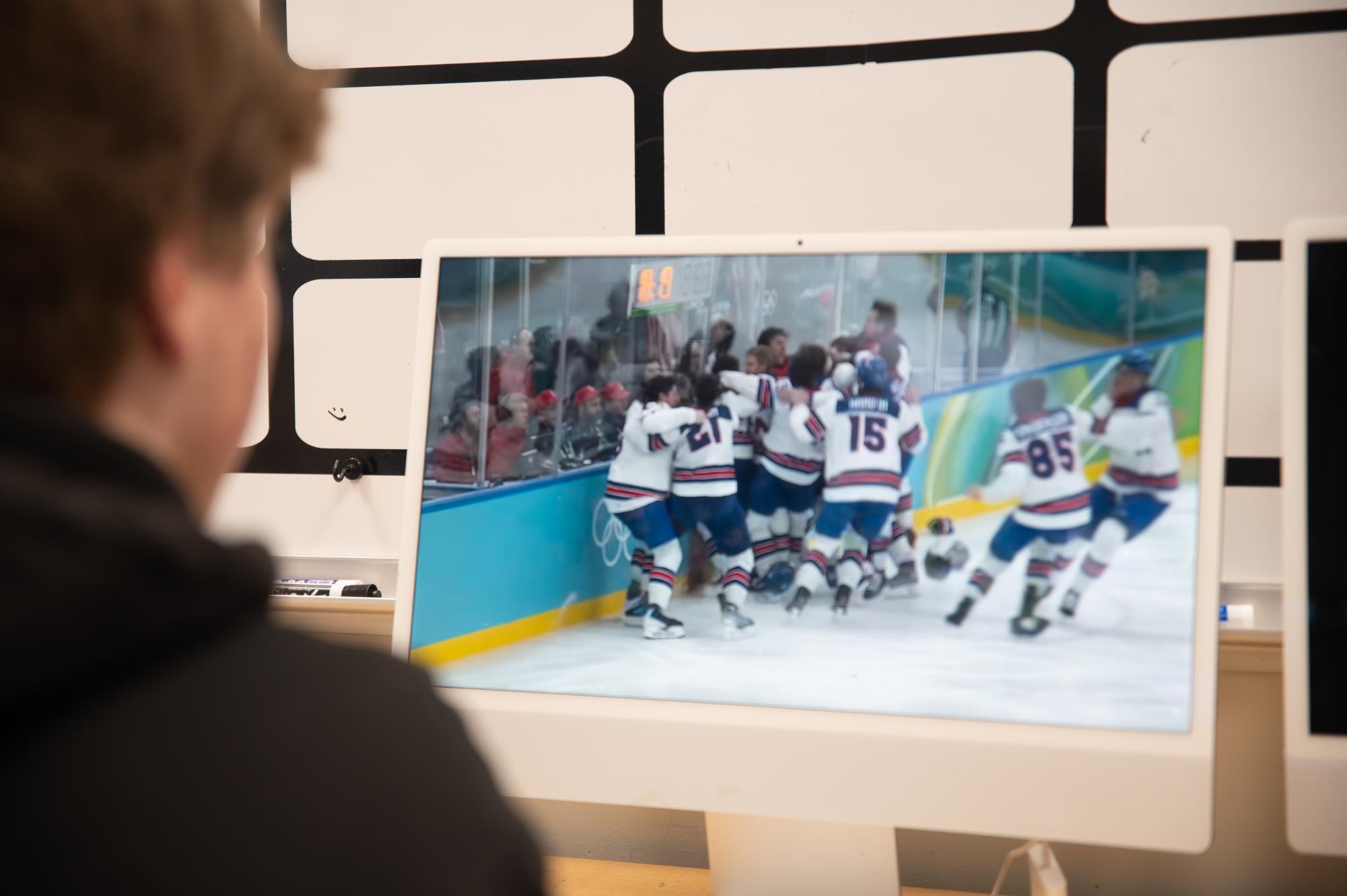


The men’s gold medal hockey game at the 2026 Winter Olympics in Milan was intensely competitive, with the United States defeating Canada 2–1 in overtime. After three periods of fast, physical play, the score remained tied late into regulation before Jack Hughes secured the victory with a game-winning goal in overtime.
Millions of fans tuned in to watch men’s and women’s Olympic hockey from Feb. 6 to Feb. 22. Showcasing speed, skill, and intensity, Olympic competition gives young athletes examples of what dedication looks like.
The Olympic Games are more than entertainment. The fast pace of the matches, intense rivalries such as Canada vs. USA, and the strong patriotism displayed by competing teams contribute to the excitement surrounding sports, showing student-athletes what can be achieved through hard work and determination. Even from thousands of miles away in Milan, Italy, this year’s Games inspired players at the high school level.
The 2026 Olympic hockey tournament featured national teams that qualified through international rankings and qualification tournaments organized by the International Ice Hockey Federation. Countries earn spots based on their performance in global competitions leading up to the Games, ensuring the top hockey nations compete. Each team’s roster is selected by national coaches and management, choosing players based on skill, experience, and team fit. The Olympic tournament begins with group-stage play and moves into elimination rounds before the final gold medal game.
“Watching the Olympics helps us lock in because it gives us motivation to do better, and watching our idols play as superstars gives us motivation to try and be that good one day,” senior and varsity boys’ hockey player Miles Lappin said.
According to Olympic rules, games are played in three twenty-minute periods, and if teams remain tied, they enter sudden-death overtime where the first goal wins the game. Moments like the dramatic finish of the gold-medal game show high school players how professional athletes respond under pressure and execute plays in critical situations.
At West High, boys’ hockey players often bring lessons from major international competitions into their own games, as coaches adapt strategies and trick plays seen at the highest levels of hockey.
“Watching the Olympics has changed my mindset on how to be a better athlete and always to have a positive attitude. [Although] the U.S. didn’t win the Four Nations [Hockey] Face Off last year, [ they still didn’t quit],” Lappin said.
The National Hockey League (NHL) 4 Nations Face-Off was an international tournament held in 2025 featuring the United States, Canada, Sweden, and Finland. Organized by the NHL, the event brought together many of the league’s top players to compete for a championship. The United States’ loss in this tournament encouraged hope and viewership for the Olympic Games, showing that a comeback is not impossible.
While the men’s tournament draws significant attention, the United States women’s national ice hockey team has been successful since the late 1990s. They won Olympic gold medals at the 1998 Nagano Winter Olympics and the 2018 PyeongChang Winter Olympics, remaining one of the top teams in the world. The success of the women’s teams continues to grow. Increased news coverage of female athletes competing for medals highlights the rapid growth of girls’ hockey and encourages young players to pursue the sport at higher levels. Girls’ and women’s hockey in the United States has grown by about 65% over the past 15 seasons. In fact, USA Hockey reached 100,000 registered female players, showing how visibility at the elite level directly inspires youth involvement.
“Women’s sports don’t usually get that much attention. Winning is like bringing more attention and support to them. I look up to Joy Dunne because, where I am [at in my career] is not that far, [we have] the same coach, and to see her doing such great things is very amazing,” junior Rylee Fahs said.
Professional female athletes are setting positive examples on both international and national stages, inspiring West High women, the next generation of competitors. Beyond hockey, this growing recognition is especially evident in basketball, where women’s college teams have seen a surge in attendance and viewership during March Madness, as programs across the country compete to determine the best team. This increased attention not only highlights the talent and competitiveness of women’s basketball but also encourages younger athletes to pursue the sport with greater confidence.
“Watching women’s March Madness shows how skilled and intense the games really are,” Fahs said. “It makes me realize that women’s sports deserve just as much attention.”
Beyond athletics, Olympic and professional competition often impacts the broader school community. Teachers and students alike follow major events, creating conversations that extend into classrooms and hallways. “Over time, I noticed more students showing up to my [academic lab] just to watch the games, particularly in the women’s hockey games, and showing more love to them and just understanding how much work goes into being that good,” English and Sports Literature teacher Kaleb Schumer said.
The influence of professional and Olympic athletes can also feel personal for students when the competitors come from their own community. Players from the St. Louis area — Matthew or Brady Tkachuk and Clayton Keller — have reached the highest level of hockey, giving local athletes a direct example of what is possible. As the Winter Olympics spotlight both men’s and women’s hockey, its influence extends far beyond international arenas. At West High, the impact can be seen in athletes striving to improve their performance and push themselves toward new goals and the dream they have been imagining.
“Even watching a player from our hometown. I also like watching both [the] Tkachuk brothers because they are from [St. Louis, and they fought the Canadian players; they get me fired up,” Lappin said.
While Olympic medals may be awarded on a global stage, the hard work behind those victories often begins locally in school rinks, team practices, and student-athletes working to represent their community. For West High’s boys and girls hockey players, the Olympics serve as a reminder that dedication, teamwork, and passion for the sport connect athletes everywhere, from world championships to high school competition.
“Watching the Olympics makes you realize that every great player started somewhere,” Lappin said. “It motivates us to work harder every time we step on the ice.”
![In game months apart, senior Brett Ottensmeyer and junior Noor Hacking stand as quarterbacks in their respective games. Ottensmeyer was a four-year quarterback for the Longhorns; Hacking served as quarterback in the 2025 powderpuff game. “There are many challenges [to being a woman in sports]. People underestimate you and you have to work extra hard to get recognition. Sports are a big part of my life because I have played sports my entire life and have grown up [seeing] women set a high standard,” Hacking said.](https://pwestpathfinder.com/wp-content/uploads/2026/05/Untitled-1.jpg)

![Stretching his arms and pushing through the water, captain of the varsity boys’ water polo team and senior Max Moore reaches for the ball during the game against Lafayette High School on April 14. The game also marked Senior Night, celebrating the seven seniors of the team. “It was a really close game the whole time, and we ended up winning six to five. I scored two goals. It's kind of sad [because this is my last season], but it's also a lot of fun,” Moore said.](https://pwestpathfinder.com/wp-content/uploads/2026/04/MBS_7153-edited-1200x801.jpg)
![West High’s girls’ and boys’ track and field school records are plastered next to the gymnasium entrance. In 2023, the girls’ varsity 4x200-meter relay team set a school record — the most recent track and field school record. “[My] freshman year, we almost made it to state. We made it to sectionals but came up short by 0.79 seconds from advancing,” Love said.](https://pwestpathfinder.com/wp-content/uploads/2026/04/DSC_1232-1-1200x800.jpg)
![Discarded to the side, Kansas City Chiefs and St. Louis Rams merchandise sits in a trash can after the two National Football League (NFL) teams left the state of Missouri. Both the National Hockey League’s (NHL) St.Louis Blues and Major League Baseball’s (MLB) St. Louis Cardinals, two other Missouri professional sports teams, have been in the city since their developments in 1967 and 1882, respectively. “St. Louis fans are incredibly loyal, judging by [the MLB’s] Cardinals and [the NHL’s] Blues. Team owners on the whole, not so much, judging by the [National Football League’s] Rams. This is more a function of ownership and profit than fan loyalty,” government teacher and football coach Melvin Trotier said.](https://pwestpathfinder.com/wp-content/uploads/2026/03/DSC5875-2-1200x900.jpg)
![With every second on the mat counting, junior Jaeda McRaven struggles against her opponent in a wrestling match. On Dec. 9, McRaven competed at a girls' wrestling tournament at Rockwood Summit. “I have been doing pretty well this season, [especially] with being able to place on the podium at some matches, but overall, [I] have been trying very hard to [qualify] for state,” McRaven said.](https://pwestpathfinder.com/wp-content/uploads/2026/03/DSC0206-1200x800.jpg)


![Senior Matthew Thomas holds up a stuffed soccer ball, a keepsake he brings to all his soccer games, including Vetta. In 2023, Thomas joined a coed team named S&R along with a group of his friends from school. “Vetta is one of the best parts of the winter season. Friday and Saturday nights playing my favorite sport with my friends is definitely a core memory,” Thomas said. “[We’ve] seen it grow more and more through our school since we started our team, and it’s good to see other friend groups making fun memories like we are.”](https://pwestpathfinder.com/wp-content/uploads/2026/01/IMG_8527-1200x800.jpeg)


Will Gonsior • Apr 12, 2026 at 1:31 pm
JOY DUNNE MENTION
THE WORLD FAMOUS OHIO STATE UNIVERSITY LEGEND
NATIONAL CHAMPIONSHIP GAME-WINNING GOAL SCORER
goat