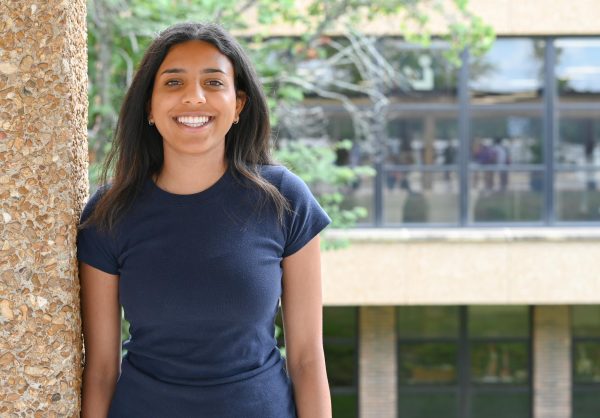
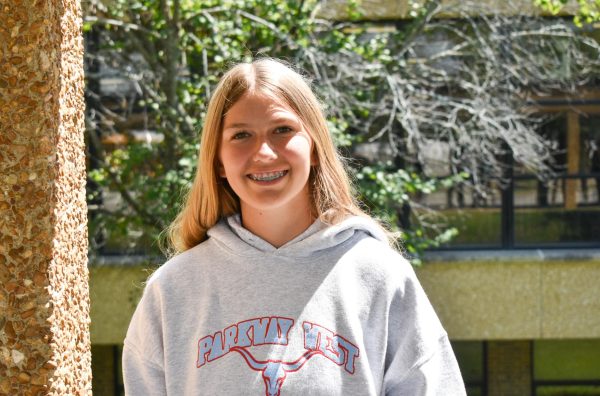
![Junior Bethany Liao and sophomore Srinidhi Sripada pass out poems at the front entrance on April 29. Sripada volunteered for the event as a member of the National English Honor Society. “I'm surprised by the [number] of people who were always excited about getting a poem,” Sripada said.](https://pwestpathfinder.com/wp-content/uploads/2026/05/DSC_0826.jpg)
“Often I think of the beautiful town / That is seated by the sea; / Often in thought go up and down / The pleasant streets of that dear old town, / And my youth comes back to me.”
National English Honors Society (NEHS), formally known as Beta Omicron Kappa, stations volunteers at entrances throughout the school to pass out poems for Poem in Your Pocket Day. This event takes place every year at the end of April — National Poetry Month; this year, it fell on April 29. The event is held in celebration of poetry and poets like Henry Wadsworth Longfellow, whose poem “My Lost Youth” celebrates the spirit of youth while also reflecting on a loss of innocence.
“[Last year], I got a poem in my pocket, and it was pretty cool. It was about chocolate. I remember what it was, and I enjoyed reading it. This year, I [wanted] to take part in the [activity] as well,” sophomore Srinidi Sripada said.
As the school year comes to an end, Poem in Your Pocket Day is a reminder of individuals’ participation in the living art of poetry. For students, keeping poems in their pockets fosters a sense of community and deepens interest in poetry.
“The importance of Poem in Your Pocket Day is [to celebrate] poetry as a form of literature. I think that poetry is underappreciated. Showing people that poetry can be something as simple as carrying a poem in your pocket the entire day [and] seeing poetry in the morning, right before you walk into school makes it accessible, because there [are] a lot of kids that probably don’t engage with poetry,” NEHS vice president and senior Ryan Shabani said. “We hand them a poem, they take it, put it in their pocket, read it and maybe later on, they’ll come back to it and think about the message for them.”
April is also National Poetry Month — NEHS celebrated at the beginning of the month with Jazz Poetry Night and a poetry-themed bulletin board.
“Anyone can be a part of poetry. There are so many different types. There’s spoken word poetry [and] there’s formal poetry. You don’t have to have every single line or stanza rhyming. It can be an open structure. Generally, poetry is accessible,” Shabani said.
![Reflecting on previous years, junior Bethany Liao looks at plaques in the Speech and Debate room. With her partner, senior Yein Ahn, Liao earned first place in Public Forum debate at the MSHAA Speech and Debate District Tournament on March 6 and 7. “I really want us to do good, and, even if we don't, I want it to be a memorable experience for [Ahn] because this is our last debate together,” Liao said.](https://pwestpathfinder.com/wp-content/uploads/2026/04/DSC_3604-1200x800.jpg)


![Seniors Charlotte Putnam and Leilani Domijan set up the Seal of Biliteracy recipient board in the main hallway. Last year, Putnam and Domijan both earned their Seal of Biliteracy in Spanish. “Earning the Seal of Biliteracy shows your determination and your willingness to move forward even when it’s hard. My advice is practice often, remember that practice makes perfect and [know] there [are] always opportunities to improve,” Domijan said.](https://pwestpathfinder.com/wp-content/uploads/2026/04/DSC_0502-2-1200x800.jpg)
![Spanish teacher Jessica Verywest and senior Zoya Hasan listen in on a conversation related to Dance Marathon funds. Dance Marathon is making the final preparations for its event on April 22, 2026. Senior Zoya Hasan talks about how she has enjoyed the process of preparing for Dance Marathon so far this year. “My favorite part of going there [Dance Marathon] with my friends Friday mornings, its been a nice routine that we get to promote Dance Marathon with,” said Hasan.](https://pwestpathfinder.com/wp-content/uploads/2026/03/DSC_0083-1200x800.jpg)
![Focused in her science class, junior Max Hahn works on her project. Hahn, anticipating her start in the college application process, has mixed emotions. “I'm excited and nervous for college. I think the [process of applying] will be hard to balance with school, because it’s for the next [chapter] of my life, but that’s also what makes it exciting. This summer, I definitely plan to [start] looking into what colleges I’m interested in so I can set [myself up for success],” Hahn said.](https://pwestpathfinder.com/wp-content/uploads/2026/03/DSC6123-1200x798.jpg)
![During a student-led walkout on Feb. 10 protesting recent actions by ICE, senior Kamori Berry became emotional at the turnout of students. Berry assisted with the coordination and planning of the walkout in the days leading up to the event. “We didn't think a lot of people were going to [show up], and when we [got there], it just made me emotional [at] how many people [were] supporting what we were doing. I was really proud of the student body and what they were doing,” Berry said.](https://pwestpathfinder.com/wp-content/uploads/2026/02/feature-revised-3-1200x804.jpg)
![Facing a large audience, senior Caitlyn Dunn recites poetry passionately. She prepared beforehand for the competition. “I [went] on the poem site and I picked a poem that seemed doable but also interesting to me, and I practiced it a lot, starting a week before the competition,” Dunn said.](https://pwestpathfinder.com/wp-content/uploads/2026/01/DSC_5875-Enhanced-NR-1200x733.jpg)
![Lifting his arms, principal John McCabe prepares to shoot a three-point shot. This was McCabe’s third time playing in the Senior vs. Staff Basketball Game. ”There’s an energy level when we're all there. It's always better when we're all together. Anytime we get to see our students on display in front of the whole school — our cheerleaders, our dancers, our band, our jazz choir — [seeing] people that work and put in all this time and effort, I love that. I love any event that allows us to showcase [all] different things,” McCabe said.](https://pwestpathfinder.com/wp-content/uploads/2026/01/DSC02741-1-1200x800.jpg)