
Emergency drills: practice isn’t making perfect
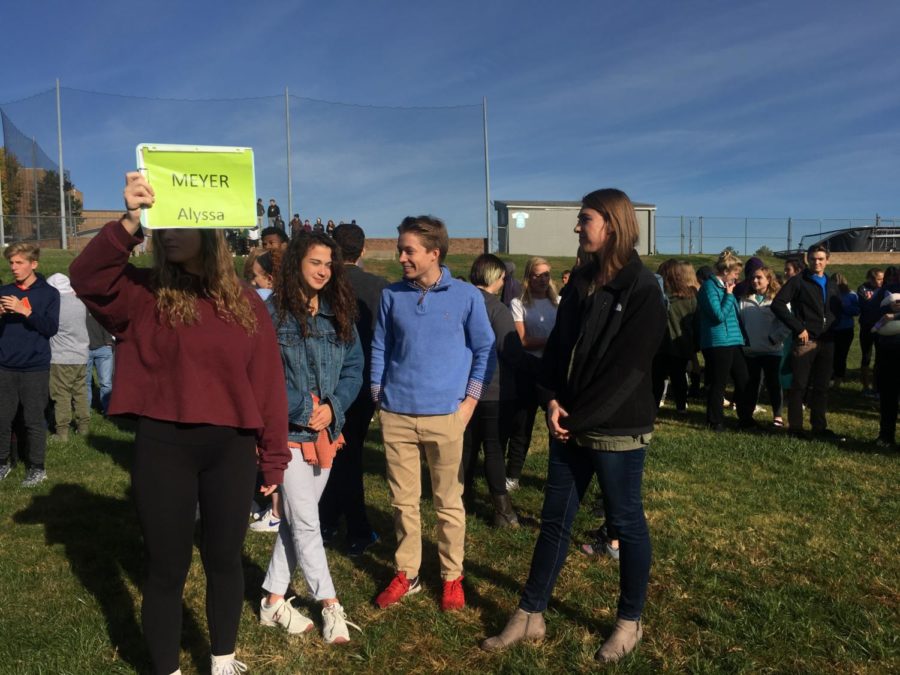
Students stand in the field behind the school during a fire drill Oct. 24 after taking an hour of the day to practice emergency drills. This day of practice followed a real fire alarm Oct. 23.
October 31, 2018
The shrill, deafening sound of the emergency alarm echoes through the halls as students rush towards exits, teachers yelling at them to stay with their class and meet in their designated area. The stairwells are packed with moving students, the thunder of footsteps drowning out what little directions are being given by the faculty. Simply put, it’s chaos. Even as students gather outside the school, the obvious disorganization prevents teachers from find their missing students, and students from finding their classes. Ten minutes and an unaccounted for class later, students and staff are given the all-clear to return to the building, despite the fact that the procedure was never fully completed, and many students were left out all-together.
With the aftermath of school shootings echoing around the country, students are realizing the dangers they could face at school, whether in fear of extreme weather or intruders. Unfortunately, the school is not providing adequate protection and emergency procedure. Besides the added security to the building, we have only practiced one intruder drill this year, compared to the multiple fire drills we’ve had already. Along with that, when drills are practiced, they are often not taken seriously. If students are to feel safe, emergency drill procedures must be updated and further catered to the challenges of today.
Intruder drills must be practiced more frequently, so that our school is prepared in the event of an emergency. While there are more school fires than school shootings across the country per year, the severity and emotional scarring that school shootings leave in their wake simply dwarfs that of school fires, and the significance of intruder drills becomes obvious. The truth is, students are scared. We see pictures of kids just like us that have been killed or injured due to shootings at school, a place where we’re supposed to be physically and emotionally safe. We remember the emotional upheaval after many mass shootings and can list them by name: Columbine, Sandy Hook, Parkland and so many more. Although the issue of gun violence cannot be solved by the school or district, we can put in place practices, such as practicing intruder drills more often, that will not only make staff and students prepared, but also make them feel safer in the place they must go everyday.
Along with the lack of intruder drills, the insufficient practicality with which they are practiced creates a dangerous environment for students. Emergencies are never expected; that’s why they’re emergencies. In a real situation, students would not be warned the week before, the day of or five minutes prior. Because schools practice them as such, students are left unfamiliar with the chaos of a real emergency when it happens: something they haven’t truly prepared for. Surprise drills must be implemented more frequently to truly test schools’ emergency preparedness. Prior to a fire drill, an administrator is required to notify the Facilities Department to ensure that the alarm reports in an accurate and timely manner. However, there is no rule requiring the faculty to advertise the drill to students. When students become accustomed to warnings and planned drills, the results vary from students abandoning their class to find their friends to some classes remaining unaccounted for and being left out of the final roll call. In some cases, some students are never tracked down, and the drill is decidedly completed despite teachers still looking for their missing class. In the case of a real emergency, students and faculty will lack the real life organization and familiarity necessary to execute the emergency response safely.
In order to truly prepare students for emergency drills, we must also emphasize efficiency and accountability in every drill. During an emergency, students must get to safety quickly, whether that’s out of the building for a fire drill or out of sight during an intruder drill. The staff must ensure that each class and student is accounted for, but with our current apathy towards the execution of these drills and procedures it is much less likely to work smoothly in a potentially dangerous situation. If we don’t start taking drills seriously, neither efficiency nor accountability could be reliably accomplished in a real emergency.
The thought that a school shooting might occur should never have to cross a student’s mind. However, due to recent events, we must think about tragedies like that, and most importantly, we need to be prepared for any emergency–especially an intruder. If the school emphasizes and practices intruder drills and surprise drills more frequently, along with ensuring efficiency in the drills, the security and safety of our school will increase, and we will further be able to live and learn in a safe environment.
Have a comment or question concerning this editorial or a suggestion for the next? Click here.
![The narrow lens contrasts with a diverse reality; whitewashing means altering or concealing something to make it more appealing to white people. The word “whitewashed” as it is used today has caused identity crises for thousands, if not millions, of students. “I have been called whitewashed before, and it feels very sad. [It’s] just hard because it makes me not know who I am. You don’t get a lot of backlash for [saying it], so I think it’s a throwaway term for people who aren’t affected by it. When you are the person [who] is being called whitewashed, over time, it builds up,” sophomore Raaga Golla said.](https://pwestpathfinder.com/wp-content/uploads/2026/01/IMG_5740-1-300x200.jpg)
![Two of Pathfinder’s most recent editorial accolades shine on display in journalism teacher Lindsey Katz’s room. Pathfinder was recognized as a SNO Distinguished Site on April 24. “Praise isn’t everything, but it feels so nice to see the hard work of our staff recognized. So much more than just writing words on a page occurs [in journalism], and I am so glad people see that. I love being surrounded by such talented writers, but also such great people,” editor-in-chief and junior Payton Dean said.](https://pwestpathfinder.com/wp-content/uploads/2026/06/DSC_4941-300x200.jpg)
![There are more than 20 open cardio machines at Crunch Fitness. I enjoyed the spacious environment at Crunch, a sentiment that was shared by sophomore Sanjana Daggubati. “[Going to] Crunch Fitness was the right decision because [it] feels more professional. Crunch’s workers are laid back, but not to the point where they don't care,” Daggubati said.](https://pwestpathfinder.com/wp-content/uploads/2025/09/IMG_5242-1-300x225.jpg)

![Setting up the activity for his first meeting, Financial Literacy Club founder and sophomore Yash Bandiananthaiah writes on the whiteboard. For the first meeting, Bandiananthaiah created an interactive experience for members to immerse themselves in. “To me, the most important thing during a meeting is to make sure we are all engaged and participating, and [I do this by] always making sure we have a hands-on activity,” Bandiananthaiah said.](https://pwestpathfinder.com/wp-content/uploads/2026/05/DSC5306-1200x798.jpg)
![Hand raised into the air, senior Lauren Anstrom watches as her graduation cap flies along with the caps of all her peers. Anstrom hopes to leave behind the legacy as someone who was kind, hardworking, and always supportive of others. “Tossing my graduation cap honestly felt surreal. In that moment, everything hit me at once with all the excitement, relief and a little sadness too. It felt really emotional [because] this was the end of such a big chapter of my life, but also exciting knowing that everyone was about to start a completely new journey,” Anstrom said.](https://pwestpathfinder.com/wp-content/uploads/2026/05/DSC_3031-Enhanced-NR-2-1200x800.jpg)
![French teacher Blair Hopkins enters City Coffee & Creperie in Clayton, Mo. for breakfast with her Honors French 4 students and AP French 5 students. Both classes went on a field trip to a fair trade chocolate factory in St. Louis to begin their unit on Côte D’Ivoire, a major producer of cocoa beans. “My ideal school would just be the Magic School Bus — you would always learn about things by going someplace and learning hands-on, being able to see it yourself and asking people questions. I think [learning is] always so much more memorable if you can experience it firsthand,” Hopkins said.](https://pwestpathfinder.com/wp-content/uploads/2026/05/DSC2795-1200x798.jpg)