
Teachers are fed up and searching for solutions
January 14, 2022
According to the Addiction Center, phone addiction is as serious of a problem as any other addiction. This behavior has been named “nomophobia,” or the fear of being without a device. Because phones are specifically designed to be a reliance in our lives, adults and students alike are becoming addicted unbeknownst to them.
The Addiction Center has established that the overuse of phones is a serious problem not only in our school but the world as a whole. English teacher Casey Holland says he goes through daily challenges when his students are distracted during his teaching.
“Before the pandemic, I would have students come in and they were assigned a slot [for their phone] and they would drop them in [at the beginning of class]. Then coming back from the pandemic, I thought, ‘I’m not going to be a babysitter.’ It’s a privilege to be at school and I thought that everybody would feel the same way,” Holland said. “But the disrespect and just the overuse is way too much. I told [my students] I will get that back out and we’ll do that, but I don’t want to because it’s a waste of instructional time.”
According to English Academic Support Center teacher Kristen Witt, students are experiencing difficulties paying attention due to the unprecedented times they are experiencing.
“[Phone addiction] is a serious problem. It’s a bigger problem this year than in any years past because for the last two years while we were online, we went unattended [on our phones] for too long. Now we are obsessed with our phones and we are not able to put them down, step away from them or do anything that is not on our phones. It is very hard to do work when you have to fight the phone,” Witt said.
While all teachers who were interviewed mentioned that student phone usage should be considered an addiction, Choir teacher Brian Parrish went as far as to compare the phone addiction to gambling.
“Well, if I spent a year and a half gambling all the time, I might be more addicted to gambling today than I was back then. Same thing with drugs. I think if you recognize the reality of [the phone addiction], you know. If you watch the “Social Dilemma” documentary, [they talk about how] when you have teams of 50 engineers whose only job is to make a game more and more addicting to young people, that’s their primary direction. You can’t blame the kid. Do you blame the 50 engineers who did their job?” Parrish said.
Teachers have different ways of dealing with students on their phones in their classrooms. Science teacher Colleen O’Toole has decided that, at least for now, she is not using a pocket organizer or taking her students’ phones daily. While she thinks this route makes it much harder for the teacher, it is worth it in the end for the students.
“I used to [take students’ phones] for my classes, but then I struggled with that one because where do we draw the line on personal responsibility? We live in a world with cell phones and that is just kind of how it is now,” O’Toole said. “When we take them, are we really teaching them how to manage that distraction with the priorities that they need to get accomplished in school? That one is really a back and forth for me. Would it make my life easier to take them away from them and would they pay attention? Yes, but I can’t be the phone police. I don’t know. I really struggle with it.”
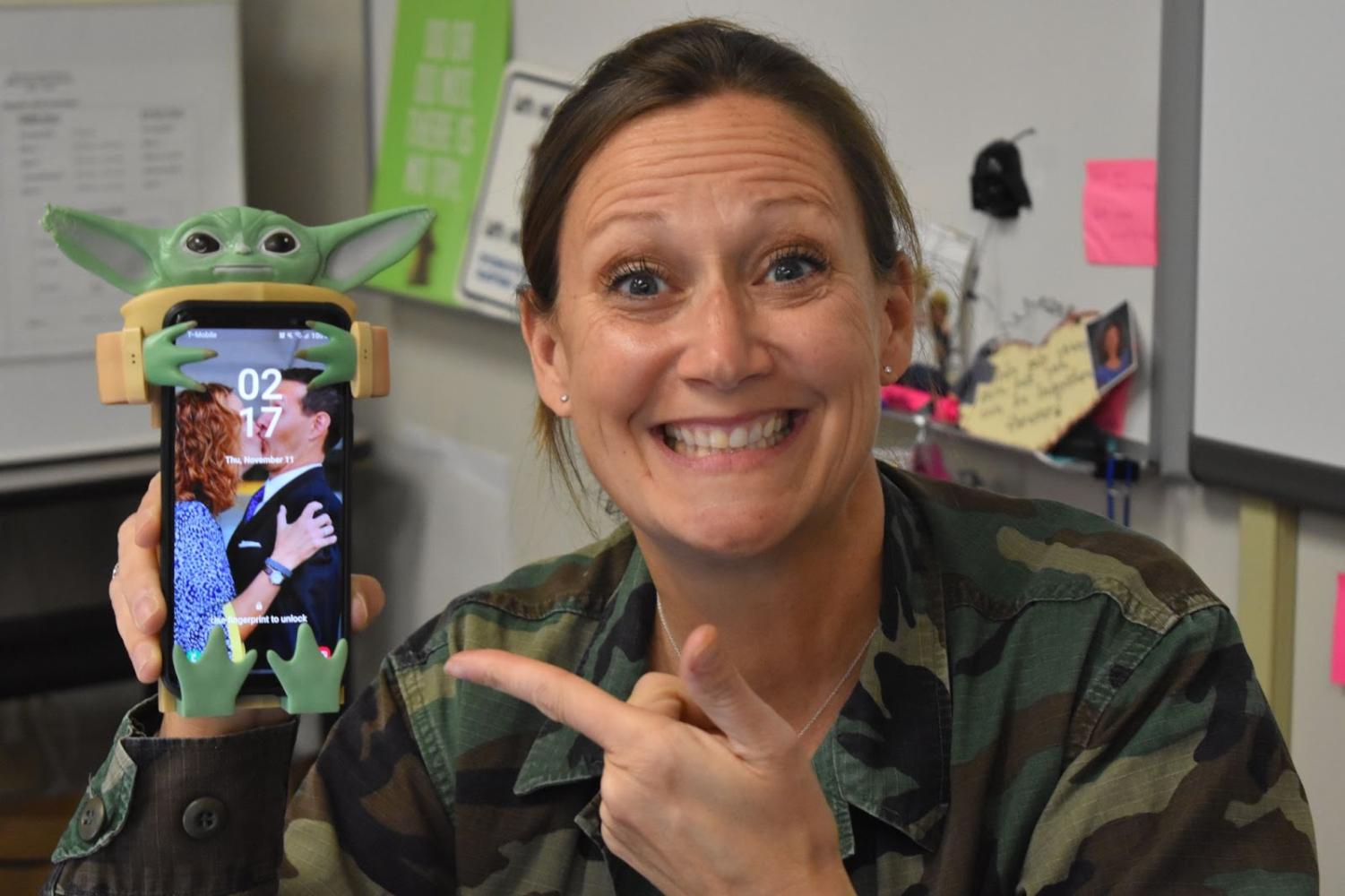
Witt has thought of a unique way to ask her students to put her phone away. She says that she has tried the pocket organizers in the past, but like O’Toole, she decided that this does not help the student.
“I hope that [students] can manage their phones on their own and if not, then I have some other ways that we can hold the phone so that we can get our work done,” Witt said. “So usually, I will offer to hold it for them. Or in extreme situations, Baby Yoda can hold them or they get an individualized phone holder. So what that means is that the phone holder would just hold your phone for you so you don’t have to worry about it and you can get your work done, but the student still decides if they want to or not in most cases.”
Witt and Spanish teacher Dominique Navarro have similar strategies, in that they give students the option to have their phones taken away at the beginning of class. Navarro discussed that phones are an even bigger problem in a language class because of the easy access to translation tools that can be used to cheat on assignments and tests.
“I have just heard from other teachers who don’t [have a phone pocket organizer] that if you don’t set a rule from the beginning of the school year, it’s harder to reinstate later. So it’d be really hard for me had I not done this from the beginning of the school year,” Navarro said. “If all of a sudden, I told all my students [in the middle of the school year] ‘Okay, now you’re gonna start putting your phones away,’ it’s gonna cause some kind of revolution. If I just say from the beginning, ‘This is my classroom. Those are my rules,’ then [the students] would technically follow them. I see other colleagues who don’t have it in their rooms, and it’s causing a lot of issues.”
Navarro has children of her own who are sophomores and freshmen and sees an uptick in their screen time as well. Students and teachers alike are working together to find solutions to this problem.
“I come home and I ask my own kids [what their screen time is], because I started realizing that we have an average screen time of five to six hours. When they come home at three and they’ve already had three hours of screen time. How is that? How is it even possible? To be on your phone for three hours when you finish school, and school is only seven hours long in the first place,” Navarro said.


![There are more than 20 open cardio machines at Crunch Fitness. I enjoyed the spacious environment at Crunch, a sentiment that was shared by sophomore Sanjana Daggubati. “[Going to] Crunch Fitness was the right decision because [it] feels more professional. Crunch’s workers are laid back, but not to the point where they don't care,” Daggubati said.](https://pwestpathfinder.com/wp-content/uploads/2025/09/IMG_5242-1-300x225.jpg)
![The narrow lens contrasts with a diverse reality; whitewashing means altering or concealing something to make it more appealing to white people. The word “whitewashed” as it is used today has caused identity crises for thousands, if not millions, of students. “I have been called whitewashed before, and it feels very sad. [It’s] just hard because it makes me not know who I am. You don’t get a lot of backlash for [saying it], so I think it’s a throwaway term for people who aren’t affected by it. When you are the person [who] is being called whitewashed, over time, it builds up,” sophomore Raaga Golla said.](https://pwestpathfinder.com/wp-content/uploads/2026/01/IMG_5740-1-300x200.jpg)
![Dressed in the traditional uniform of the US Air Force, sophomore Eric Thomas stands in front of the US flag. Thomas joined Civil Air Patrol on Jan. 14, 2024, and has since risen rapidly through the ranks. He is currently at the position of Chief Master Sergeant. “Not everybody gets a chance to wear a uniform as prestigious as [the] United States Air Forces[‘]. Having the ability to wear it is truly an honor, [because] it lets me represent some of the core values that I am required to uphold while in the program," Thomas said.](https://pwestpathfinder.com/wp-content/uploads/2026/04/DSC_0003-300x200.jpg)
![Performing at the Fabulous Fox for the 16th Annual St. Louis Teen Talent Competition, junior Alisha Yin delivers her Program Oral Interpretation titled “Ways to Find Your Voice.” Yin centered her piece around Jimmy Kimmel’s suspension and First Amendment rights. “[Yin] has worked really hard to get here. She is persistent. She doesn’t give up. Even if something seems out of reach, she does a lot better than other people at always trying to [reach her goals]. She always advocates for what she believes, [so it] has always reflected her ideas or priorities,” junior Lillian Chen said.](https://pwestpathfinder.com/wp-content/uploads/2026/02/DSC_9907-2-300x200.jpg)
![Setting up the activity for his first meeting, Financial Literacy Club founder and sophomore Yash Bandiananthaiah writes on the whiteboard. For the first meeting, Bandiananthaiah created an interactive experience for members to immerse themselves in. “To me, the most important thing during a meeting is to make sure we are all engaged and participating, and [I do this by] always making sure we have a hands-on activity,” Bandiananthaiah said.](https://pwestpathfinder.com/wp-content/uploads/2026/05/DSC5306-1200x798.jpg)
![Hand raised into the air, senior Lauren Anstrom watches as her graduation cap flies along with the caps of all her peers. Anstrom hopes to leave behind the legacy as someone who was kind, hardworking, and always supportive of others. “Tossing my graduation cap honestly felt surreal. In that moment, everything hit me at once with all the excitement, relief and a little sadness too. It felt really emotional [because] this was the end of such a big chapter of my life, but also exciting knowing that everyone was about to start a completely new journey,” Anstrom said.](https://pwestpathfinder.com/wp-content/uploads/2026/05/DSC_3031-Enhanced-NR-2-1200x800.jpg)
![French teacher Blair Hopkins enters City Coffee & Creperie in Clayton, Mo. for breakfast with her Honors French 4 students and AP French 5 students. Both classes went on a field trip to a fair trade chocolate factory in St. Louis to begin their unit on Côte D’Ivoire, a major producer of cocoa beans. “My ideal school would just be the Magic School Bus — you would always learn about things by going someplace and learning hands-on, being able to see it yourself and asking people questions. I think [learning is] always so much more memorable if you can experience it firsthand,” Hopkins said.](https://pwestpathfinder.com/wp-content/uploads/2026/05/DSC2795-1200x798.jpg)