
Getting to know American Sign Language teacher Tiffani Symons
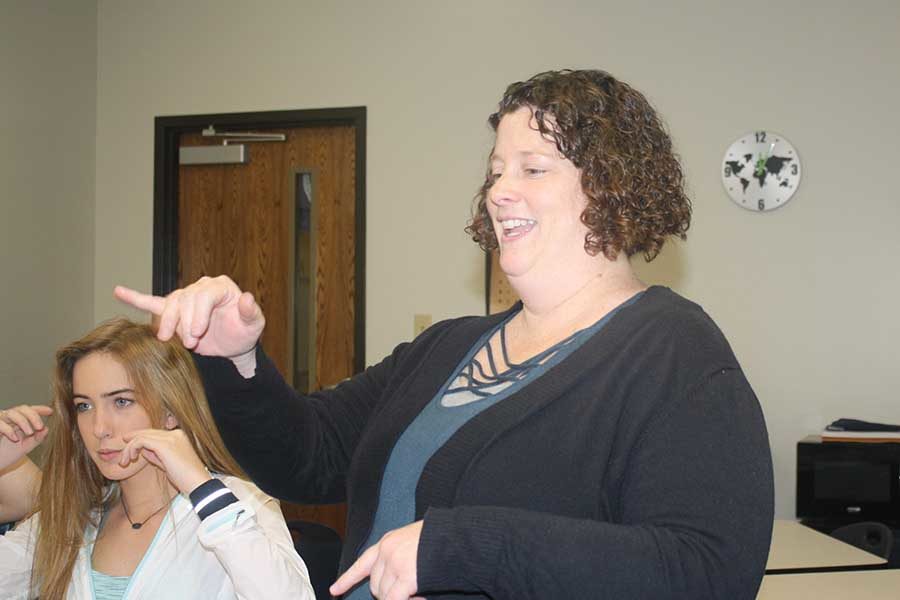
ASL teacher Tiffani Symons signs to one of her students in her American Sign Language II class. Symons has been teaching for 17 years. “Students are only learning visually. I admire students who are up for this challenge, and my job as a teacher is to promote their learning and success,” Symons said.
February 23, 2018
Pathfinder: What got you interested in teaching?
Symons: “I wanted to be a teacher since I was in high school. I realized I wanted to teach deaf and hard of hearing students, so I became a teacher for deaf and hard of hearing [students] and have been for 17 years. This opportunity to teach all students is amazing, especially because I get to teach American Sign Language (ASL) and Deaf Culture.”
What class(es) do you teach?
“I teach American Sign Language I and American Sign Language II.”
Is this your first year teaching?
“This is not my first year teaching, yet it is my first year teaching American Sign Language.”
I heard you were returning to West, what made you decide to come back?
“I learned that Parkway was including American Sign Language in their Modern and Classical Languages department. (This started here at West High two years ago) I saw the position was open, and I wanted to return to teaching again. I was also a teacher here with the Special School District (SSD) Deaf and Hard of Hearing (DHH) program four years ago. I felt so welcomed here at West High when the DHH program came. I feel that same way now coming back as a Parkway West staff member now. While I was gone, I had another daughter who is now 4 years old, and I became a state licensed sign language interpreter.”
Did you previously teach at a different school? If so, what school?
“I taught in many schools in the Chicago area for most of my teaching. [I taught in] elementary, middle and high school programs where deaf and hard of hearing students attended. I enjoyed the various grade level experiences but have always felt high school level was the best match or me.”
Are there any teaching strategies you are using at West that you learned at your previous school?
“It’s important to me that students feel confident in their learning and encouraged in new class experiences like taking ASL. ASL is a visual language, and there is no spoken language in ASL. That in itself is a big difference from traditional foreign language classes. Deaf culture is so rich in history, and it influences the users of ASL in so many ways. So then, students experience the culture shock as well.”
Why did you decide to teach Sign Language?
“I have been communicating in ASL since I was 11 years old. I was raised by deaf parents who communicated in ASL. I learned ASL from being immersed in the language and culture. My husband is also deaf, and we are working to teach our two daughters ASL. I think learning from language immersion is the best because the native ASL users are the best teachers. I enjoy seeing young people interested in ASL and having goals of learning ASL and using it in a career field in the future.”
If you could teach another subject, what subject would it be and why?
“I absolutely love history and would love to teach it. I have been researching schools that provide a Deaf History course, something I may like to do at some point. It is amazing how history influences the present and to learn about the past.”
Are there any challenges you face while teaching?
“I want to give my students the best experiences and learning I can. I feel challenged to always teach them real-life applications. At times, young people may not be able to fully comprehend how a certain subject or language will be useful to them in the real world. I want to bring those real-world experiences into my classroom. I also would venture to say it can be a challenge to teach students a language that is only visual and that there is very little oral communication in my classroom. That takes some getting used to as a first-year ASL student.”
What are you most excited for about your class/this year?
“Seeing ASL I students develop communication skills in a new language. Giving ASL II students language immersion by having deaf community leaders and people come into our classroom.”
What is your favorite thing about West?
“People here are indeed like family. I felt welcomed back here like I had not been gone for four years. The students are very motivated and have so much to share. They have been very welcoming to me as their new ASL teacher.”
What are your goals for this year?
“To give students an amazing new journey into American Sign Language and the Deaf community. We are so fortunate to have deaf and hard of hearing students and staff right here at West High who also want to encourage them in their learning. I am hoping to bring in some deaf guest speakers to our classroom as well from all over the U.S.”
How would you like students to see you?
“As a teacher who is interested in what they have to say or what they are thinking. I love collaboration.”
![The narrow lens contrasts with a diverse reality; whitewashing means altering or concealing something to make it more appealing to white people. The word “whitewashed” as it is used today has caused identity crises for thousands, if not millions, of students. “I have been called whitewashed before, and it feels very sad. [It’s] just hard because it makes me not know who I am. You don’t get a lot of backlash for [saying it], so I think it’s a throwaway term for people who aren’t affected by it. When you are the person [who] is being called whitewashed, over time, it builds up,” sophomore Raaga Golla said.](https://pwestpathfinder.com/wp-content/uploads/2026/01/IMG_5740-1-300x200.jpg)

![A board in the Parkway West counseling department displays pennants of selective universities. With a wide range of students interested in attending, it’s important that these schools have clear priorities when deciding who to admit. “[Washington University] had the major that I wanted, psychology, philosophy, neuroscience. That's a holistic study of the brain, and [WashU is] the only college in the world that offers that. That's the main reason I wanted to go; I got into that program,” senior Dima Layth said.](https://pwestpathfinder.com/wp-content/uploads/2025/02/Flag-1-300x200.png)
![Setting up the activity for his first meeting, Financial Literacy Club founder and sophomore Yash Bandiananthaiah writes on the whiteboard. For the first meeting, Bandiananthaiah created an interactive experience for members to immerse themselves in. “To me, the most important thing during a meeting is to make sure we are all engaged and participating, and [I do this by] always making sure we have a hands-on activity,” Bandiananthaiah said.](https://pwestpathfinder.com/wp-content/uploads/2026/05/DSC5306-1200x798.jpg)
![Hand raised into the air, senior Lauren Anstrom watches as her graduation cap flies along with the caps of all her peers. Anstrom hopes to leave behind the legacy as someone who was kind, hardworking, and always supportive of others. “Tossing my graduation cap honestly felt surreal. In that moment, everything hit me at once with all the excitement, relief and a little sadness too. It felt really emotional [because] this was the end of such a big chapter of my life, but also exciting knowing that everyone was about to start a completely new journey,” Anstrom said.](https://pwestpathfinder.com/wp-content/uploads/2026/05/DSC_3031-Enhanced-NR-2-1200x800.jpg)
![French teacher Blair Hopkins enters City Coffee & Creperie in Clayton, Mo. for breakfast with her Honors French 4 students and AP French 5 students. Both classes went on a field trip to a fair trade chocolate factory in St. Louis to begin their unit on Côte D’Ivoire, a major producer of cocoa beans. “My ideal school would just be the Magic School Bus — you would always learn about things by going someplace and learning hands-on, being able to see it yourself and asking people questions. I think [learning is] always so much more memorable if you can experience it firsthand,” Hopkins said.](https://pwestpathfinder.com/wp-content/uploads/2026/05/DSC2795-1200x798.jpg)